CNC machining lead time is rarely controlled by machine time alone. The quoted schedule also depends on material availability, setup strategy, fixture planning, tolerance review, inspection load, finishing, shipping, and how many questions the supplier must ask before production can start. For overseas buyers, one missing drawing note or unclear finish requirement can cost more time than the actual milling operation.
This guide focuses on the parts of lead time that engineers and buyers can influence before submitting an RFQ. It is written for teams that need fast CNC parts but still need predictable fit, material compliance, and inspection results.
Start With the Lead-Time Drivers You Can Control
Search results for CNC lead time consistently point to the same pattern: faster delivery comes from simpler decision-making before production, not from asking the machine shop to rush every step. A supplier can accelerate an order when the geometry is manufacturable, the material is available, the drawing is complete, and the inspection plan is proportional to the function of the part.
Machine shops usually lose time in five places: quote clarification, raw material sourcing, programming and fixturing, machining and secondary operations, and final inspection. If a part needs special alloy certification, imported stock, hard anodizing, tight flatness, or cosmetic review, those steps need to be visible at RFQ stage. If they appear after the order is placed, the supplier must recheck price, routing, and schedule.
| Lead-time driver | What usually slows the order | How to reduce delay without lowering quality |
|---|---|---|
| Incomplete RFQ | Missing material, quantity, revision, surface finish, or tolerance notes | Send 3D CAD, 2D drawing, quantity breaks, target delivery date, and any critical features together. |
| Material sourcing | Special alloys, unusual thicknesses, imported certificates, or low-volume stock | Ask whether an equivalent standard stock size or grade is acceptable before freezing the design. |
| Complex setups | Deep pockets, multiple orientations, thin walls, undercuts, or hard-to-hold geometry | Allow fixture pads, larger radii, accessible datum surfaces, and realistic wall thickness. |
| Inspection load | Tight tolerances on non-critical features or unclear GD&T | Identify critical-to-function features and apply general tolerances elsewhere, such as ISO 2768 where appropriate. |
| Finishing queue | Anodizing, plating, heat treatment, coating, passivation, or marking after machining | Separate cosmetic requirements from functional requirements and confirm masking or thread protection early. |
Build an RFQ Package That Removes Clarification Loops
A fast quote is not the same as a reliable quote. A useful CNC supplier needs enough information to understand geometry, function, and acceptance criteria. The 3D model defines shape, but the drawing tells the shop what cannot be guessed from the model: thread callouts, tolerance blocks, material condition, finish, deburring, inspection requirements, and revision control.
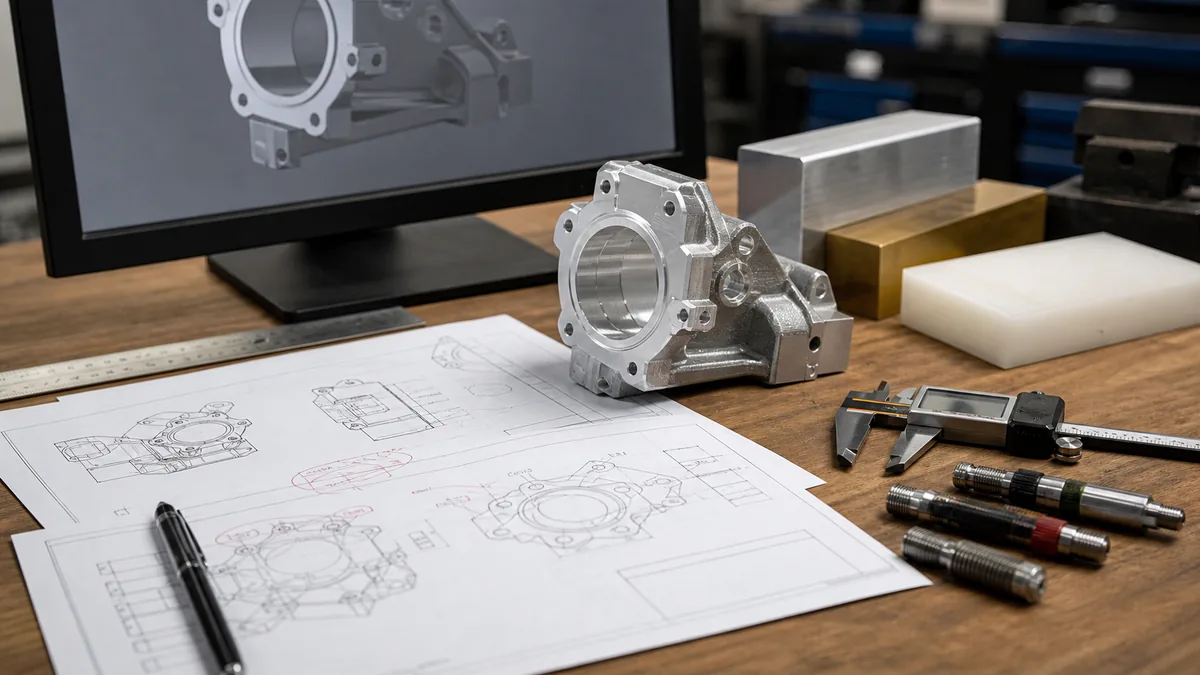
For CNCMAVEN projects, a practical RFQ package should include the native CAD file or STEP file, a PDF drawing, annual or batch quantity, target delivery date, material grade and temper, surface finish, critical dimensions, threaded holes, inserts, engraving or marking, and any assembly interfaces. If the part has a mating component, include the context or the mating dimension. If it is a prototype and the tolerance can relax after testing, say so.
Buyers often try to save time by sending only a model. That can work for simple prototypes, but it usually slows parts with threads, sealing faces, bearing fits, cosmetic surfaces, or post-processing. The supplier will either quote with assumptions or ask follow-up questions. Both outcomes create risk. A complete RFQ may take longer to prepare internally, but it usually shortens the total path from quote to approved parts.
Design Choices That Compress the Manufacturing Route
Lead time improves when the part can be machined with standard tools and stable workholding. Large internal corner radii are faster than sharp pockets because they allow stronger cutters. Open pockets are faster than deep narrow cavities because chips clear more easily. Standard hole sizes reduce tool changes. A flat, accessible datum makes inspection and setup more predictable.
Thin walls are a common schedule trap. They can vibrate, move after clamping, or distort during finishing. If the wall is not functionally required, increasing thickness may save more time than negotiating a rush fee. Similarly, tight surface roughness on every face may push the order through additional finishing or inspection. Specify roughness only where friction, sealing, fatigue, or appearance truly matters.
Use Tolerances to Protect Function, Not Every Dimension
Unnecessary precision is one of the easiest ways to add days. A drawing full of ±0.01 mm tolerances forces extra review, slower cutting, more inspection, and sometimes additional setups. The better approach is to separate critical-to-function features from reference or clearance features. Bearing bores, dowel locations, sealing surfaces, and assembly datums may need tight control. Clearance pockets, external outlines, non-mating faces, and cosmetic edges often do not.
General tolerances can be handled through a standard such as ISO 2768 when the drawing and application allow it. CNCMAVEN already has a guide to ISO 2768 for CNC machining tolerances, and that approach can reduce back-and-forth when the functional tolerance strategy is clear.
| Feature type | Typical lead-time risk | Better specification approach |
|---|---|---|
| Bearing or dowel location | High inspection load and possible rework if datum scheme is unclear | Define datum references, tolerance zone, and inspection method. |
| General profile or clearance edge | Over-controlled dimensions slow programming and inspection | Use a general tolerance unless the edge controls fit. |
| Threads | Ambiguous depth, class, or insert requirement causes quoting questions | State thread standard, depth, through/blind condition, and insert brand if required. |
| Cosmetic face | Unexpected sanding, bead blasting, or coating adds queue time | Define visible surfaces and acceptable tool marks early. |
Plan Secondary Operations Before You Promise a Date
Machining may be only one part of the schedule. Heat treatment, anodizing, powder coating, electroless nickel plating, bead blasting, passivation, laser marking, hardware insertion, and dimensional reporting all add routing steps. Some of these steps require outside processing, masking, baking, or cure time. If the project schedule is tight, ask the supplier to quote two routes: machined-only prototype parts first, and finished production-intent parts second.
Splitting the order can be useful when the first priority is fit check. For example, a buyer can approve geometry on bare machined aluminum while the supplier prepares the finishing plan for the next batch. This avoids waiting for coating before discovering that a slot, thread, or interface needs revision.
CNC Lead-Time Checklist Before Sending the RFQ
- Send both 3D CAD and a controlled PDF drawing with revision number.
- Separate critical tolerances from general tolerances.
- Confirm material grade, temper, certification, and acceptable alternatives.
- Identify surfaces that need cosmetic finishing or special roughness.
- Call out threads, inserts, press fits, sealing faces, and datum features clearly.
- State prototype, bridge production, or production intent because routing may differ.
- Ask whether finishing, inspection reports, or packaging are on the critical path.
For projects that need immediate supplier review, CNCMAVEN’s CNC machining service team can review manufacturability, material options, and inspection requirements before production planning begins.
FAQ
What is a normal CNC machining lead time?
Simple prototypes can often be produced faster than complex production parts, but the real schedule depends on material, geometry, tolerance, finishing, inspection, and shipping. Ask for a schedule by routing step instead of one total number.
Can tighter tolerances increase CNC lead time?
Yes. Tight tolerances often require slower cutting, more stable setups, extra inspection, and sometimes rework. Apply tight tolerances only to features that control fit, motion, sealing, or safety.
Does an instant quote guarantee a fast delivery?
No. Instant quotes are useful for budgeting, but delivery still depends on review, material availability, manufacturability, secondary operations, and acceptance criteria.