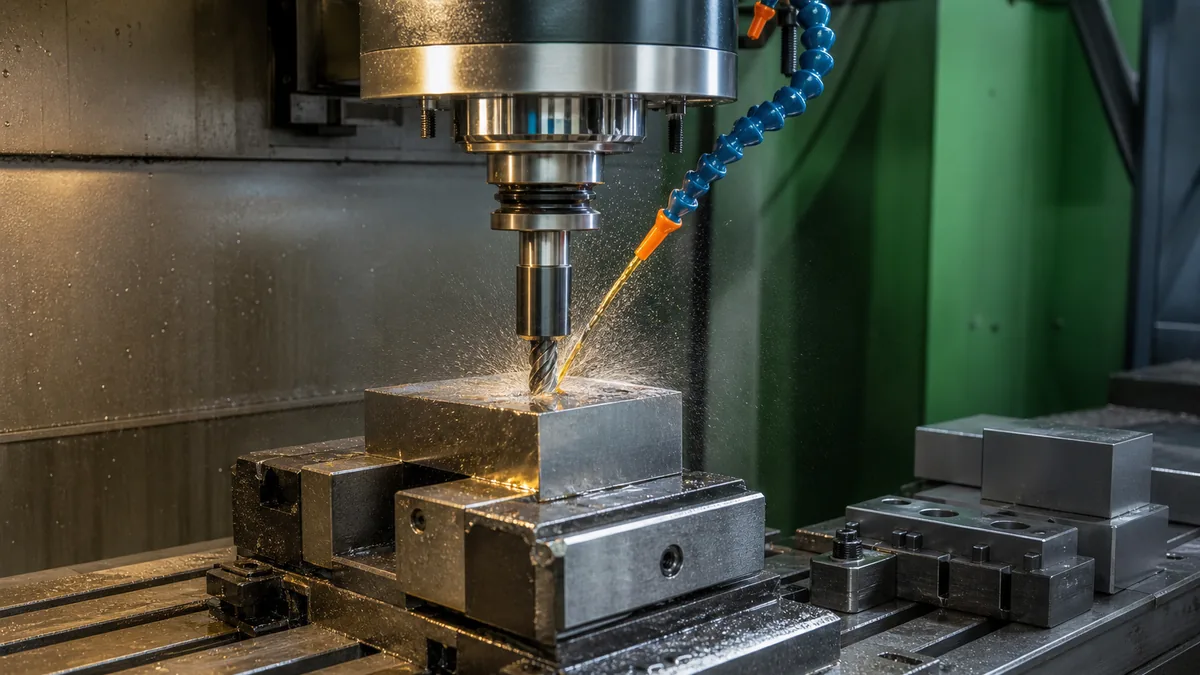
Tool steel is chosen when a machined part must survive wear, impact, heat, or repeated contact with other materials. It is common in dies, punches, mold components, gauges, cutter bodies, wear plates, fixtures, and forming tools. The difficulty is that tool steel is rarely just “machined and done.” Most projects involve rough machining, heat treatment, finish machining or grinding, hardness inspection, and sometimes surface finishing. Missing one of those steps can turn a strong material into an expensive rework problem.
This guide helps buyers and engineers specify tool steel CNC machining with fewer surprises around grade selection, hardness, tolerance, and cost.
Start with the working condition, not the grade name
Many RFQs begin with a familiar grade such as D2, A2, O1, H13, S7, or P20. That is useful, but the grade should come from the actual duty cycle. Is the component resisting abrasion, impact, hot work, compression, or dimensional movement? A wear plate for abrasive sliding contact may need different steel than a shock-loaded punch. A mold insert exposed to heat and polish requirements may not behave like a cold-work die block.
If the design is still flexible, describe the application before locking the material. CNCMAVEN can often help compare machinability, heat treatment response, availability, and finishing risk against the required function. For some low-volume tools, pre-hardened steel may reduce lead time. For high-wear tooling, annealed machining followed by heat treatment and finish grinding may be worth the extra schedule.
Common tool steel choices for machined parts
| Grade family | Typical use | Machining concern | Specification advice |
|---|---|---|---|
| D2 cold-work steel | Wear-resistant dies, punches, slitters | Abrasive carbides increase tool wear | Leave stock for grinding after heat treatment if tight tolerance is required |
| A2 air-hardening steel | General tooling with better dimensional stability | Still needs heat-treatment allowance | Good option when distortion control matters |
| O1 oil-hardening steel | Small tools, gauges, simple dies | More distortion risk during hardening | Use for simpler shapes or where final grinding is planned |
| H13 hot-work steel | Die casting, hot forming, extrusion tooling | Heat resistance and polish needs drive processing | Specify hardness, thermal cycling conditions, and surface finish |
| P20 pre-hardened mold steel | Mold bases, prototypes, moderate-wear inserts | Machined in hardened condition | Useful when avoiding separate hardening reduces lead time |
| S7 shock-resisting steel | Impact tools and punches | Balance toughness and hardness | State impact loading and edge geometry clearly |
Plan the machining route around heat treatment
The route is often more important than the cutting program. For annealed tool steel, rough machining is easier and cheaper, but the part may move during hardening. For pre-hardened or hardened stock, machining is slower and tool wear increases, but the part may avoid distortion from a later heat treatment step. For precision tooling, a typical route is saw cut, stress relief if needed, rough CNC machining, heat treatment, finish grinding or hard milling, inspection, and final surface treatment.
Sharp internal corners should be avoided where possible. Tool steel parts often work under load, and small radii reduce stress concentration while making machining more realistic. Deep pockets, thin walls, and interrupted cuts increase cost because they require conservative feeds, shorter tools, and more inspection. If a sealing or sliding face must be flat after heat treatment, do not rely on rough machining alone. Leave finishing stock and define the final process.
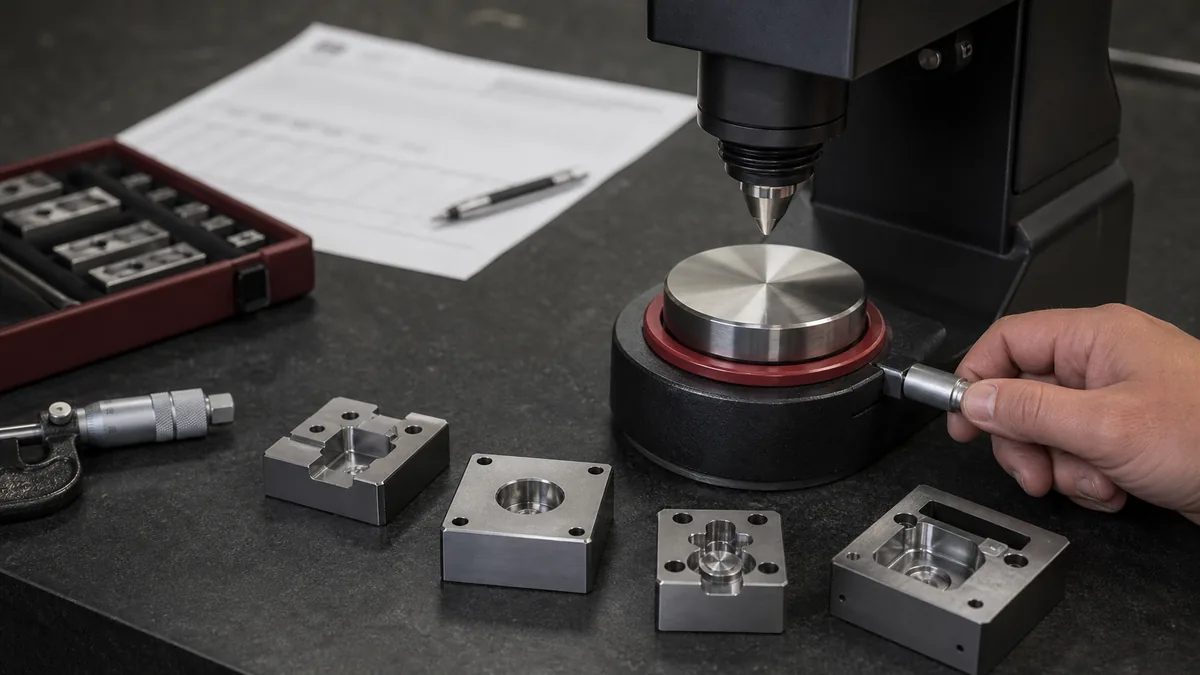
DFM checklist for tool steel RFQs
- State whether the material should be supplied annealed, pre-hardened, or hardened to a target HRC range.
- Identify dimensions that must be held after heat treatment, not only after rough machining.
- Call out grinding stock or finish machining allowance on precision faces.
- Avoid deep narrow slots unless they are truly required; they increase tool deflection and EDM cost.
- Use realistic internal corner radii based on cutter size and part function.
- Define surface finish for sliding, sealing, polishing, and noncritical faces separately.
- Specify inspection: hardness test locations, flatness, parallelism, hole position, and critical edge condition.
Cost drivers buyers should expect
Tool steel machining costs more when hardness, carbide content, and geometry fight the cutting tool. D2 and other high-carbide grades can be punishing on cutters. Hardened machining may require coated carbide, reduced depth of cut, high machine rigidity, and careful temperature control. Small batches can also carry setup and programming time that does not disappear just because the part is small.
Heat treatment adds its own cost and risk. Distortion, scale removal, hardness verification, and rework allowance should be discussed before production. If the part requires EDM, grinding, polishing, nitriding, black oxide, or coating after machining, the supplier needs the full route up front. A quote based only on milling time will be misleading.
When CNC machining is not enough by itself
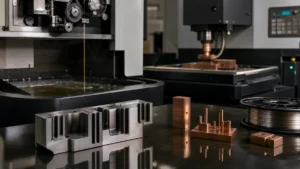
Some tool steel features are better made with wire EDM, sinker EDM, or grinding after CNC roughing. Thin ribs, square internal corners, fine slots, and hardened profiles can be difficult or uneconomical to mill directly. A hybrid route may be the right answer: CNC rough the block, heat treat, EDM the sharp profile, grind the datum faces, then inspect. This is not overcomplication; it is often how precision tooling stays stable.
For related manufacturability planning, see CNCMAVEN’s CNC machining services, DFM considerations for CNC milling, and wire EDM machining guide. These resources help decide where milling, EDM, and finishing should split the work.
Practical takeaway
Tool steel is a system, not only a material line item. The grade, hardness, heat treatment route, machining sequence, finishing method, and inspection plan must support each other. A good RFQ tells the supplier what the part must survive, which surfaces matter after heat treatment, and how the final hardness and dimensions will be verified. That gives the buyer a more realistic price and a much lower risk of late-stage rework.
Can hardened tool steel be CNC machined?
Yes, but it usually requires rigid machines, carbide tooling, conservative cutting data, and clear expectations for surface finish and tolerance. Grinding or EDM may still be needed for precision features.
Should tool steel be machined before or after heat treatment?
Rough machining before heat treatment is common, followed by finish machining, grinding, or EDM afterward. Pre-hardened steel can reduce distortion risk, but machining is slower and grade options are different.