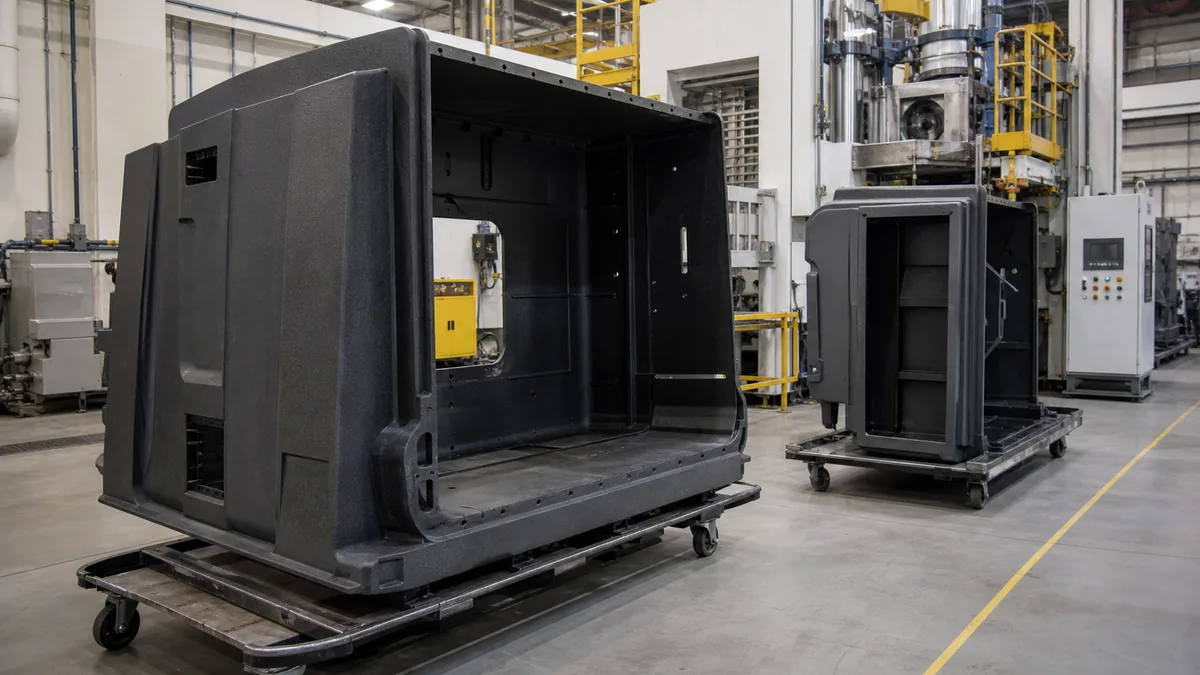
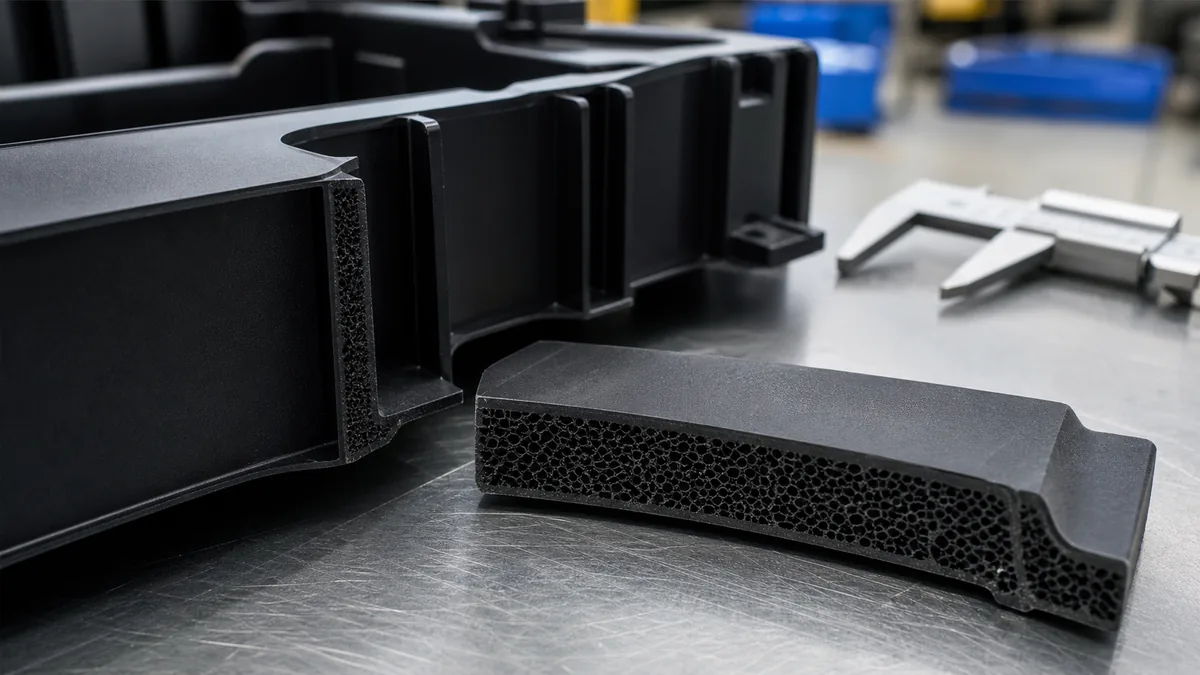
Structural foam molding is a practical option when a plastic part needs stiffness, thick walls, and lower part stress, but does not require the fine detail or thin-wall efficiency of conventional injection molding. It is often used for equipment enclosures, machine covers, pallet and material handling parts, medical device housings, and industrial panels. The process creates a molded part with a solid outer skin and a cellular core, which helps reduce weight and sink while keeping the part rigid.
How the cellular core changes the design
In conventional injection molding, thick plastic sections are usually a warning sign because they can cause sink marks, long cooling cycles, and internal stress. Structural foam molding changes that balance by introducing gas or a foaming action into the melt. The outer surface forms a denser skin against the mold, while the inside develops a lighter cellular structure. This allows thicker sections and large panels that would be hard to mold cleanly by standard injection molding.
The benefit is not free. Structural foam parts generally have a lower-pressure, lower-clamp-force process window and a different surface appearance. The surface may show swirl, flow texture, or a less glossy finish unless secondary finishing is planned. For hidden industrial parts this is often acceptable. For consumer-facing parts, the buyer should define whether painting, texturing, sanding, or another finishing step is required. CNCMAVEN’s surface finishing services are relevant when molded parts need a controlled exterior appearance after production.
DFM checklist for large enclosures
The starting point is wall strategy. Structural foam can tolerate thicker walls than standard injection molding, but the part should still avoid abrupt mass changes. Large flat panels should use shape, ribbing, bosses, and edge returns to create stiffness instead of simply adding more plastic everywhere. Ribs can usually be more robust than conventional injection molding ribs, yet they still need draft, radii, and reasonable spacing so material can fill and the part can eject.
- Define a nominal wall thickness range before adding ribs or bosses.
- Use ribs and edge returns to stiffen panels rather than over-thickening the entire wall.
- Add generous radii where ribs meet walls to reduce stress and improve material flow.
- Keep screw bosses supported with gussets, but avoid isolated towers that invite voids or weak knit areas.
- Plan the parting line, gate location, and ejector marks around cosmetic and assembly zones.
- Confirm where CNC machining, drilling, threaded inserts, or metal hardware will be added after molding.
Structural foam vs. injection molding vs. fabrication
| Option | Use when | Strength | Limitation |
|---|---|---|---|
| Structural foam molding | The part is large, thick, rigid, and industrial in appearance. | Lower stress, good stiffness-to-weight, economical large molds. | Surface finish is less refined without post-finishing. |
| Standard injection molding | The part needs thin walls, detailed features, clips, and high repeatability. | Excellent detail and high-volume efficiency. | Large thick parts can drive tooling cost, sink, and clamp tonnage. |
| Compression molding | The material is rubber, thermoset, or a simpler thick geometry. | Good for certain materials and moderate tooling complexity. | Less suitable for complex large thermoplastic enclosures. |
| CNC machining or sheet fabrication | Volume is low, tolerances are tight, or the design is still changing. | Fast iteration and accurate holes, slots, and mounting features. | Higher unit cost and material waste for large plastic bodies. |
Common defects and how to prevent them
Structural foam problems usually come from treating it like ordinary injection molding. A buyer may request a high-gloss consumer finish when the process naturally produces a textured surface, or a designer may add tall unsupported bosses without considering gas distribution and local strength. Large parts also magnify mold-flow and cooling issues. Early supplier feedback on gate location, material grade, wall transitions, and post-finishing can prevent expensive mold changes.
| Risk | What it looks like | Prevention |
|---|---|---|
| Uneven surface texture | Swirl or flow pattern in visible areas | Use intentional mold texture, paint, or place cosmetic surfaces away from gates. |
| Weak boss or insert area | Cracking around screws or hardware | Add gussets, radii, metal inserts, and load testing around fasteners. |
| Panel flex | Large cover feels soft under hand load | Add ribs, crowns, edge returns, or local thickness only where load requires it. |
| Void or poor core formation | Inconsistent cross-section strength | Review material, wall thickness, gate location, and foaming process settings. |
Material and finishing decisions
Common structural foam materials include polypropylene, polyethylene, ABS, polycarbonate blends, and engineering thermoplastics selected for stiffness, impact resistance, temperature exposure, and chemical compatibility. The material should be chosen with the real environment in mind. A machine enclosure in a coolant-rich workshop has different needs than a medical cart panel or a logistics pallet. For outdoor parts, UV stability and color retention matter. For parts near electronics, dimensional stability, flame rating, and insert retention may matter more.
Finishing should be discussed early. If the molded texture is acceptable, the part may only need trimming, deburring, cleaning, and inspection. If the product must match brand colors or hide flow marks, painting or coating may be required. If holes, datum pads, sealing grooves, or precise mounting surfaces are needed, CNC secondary machining should be defined as a controlled operation rather than left to manual drilling. This is where a combined molding and machining supplier can reduce handoff risk.
Supplier questions before tooling
Before approving tooling, ask the supplier how they will control wall thickness, core consistency, gate marks, ejector marks, and cosmetic surfaces. Ask which dimensions are molded as-cast and which are machined after molding. Request a first-article plan that includes dimensional inspection, visual criteria, insert pull testing where needed, and assembly fit checks. For enclosures, it is also useful to test hinge, latch, gasket, and screw performance after environmental exposure, not only at room temperature immediately after molding.
| Question | Why it matters |
|---|---|
| Where are the gates and visible flow paths? | This predicts cosmetic risk and potential weak areas. |
| Which features need post-machining? | This separates molded capability from precision requirements. |
| How will inserts or hardware be validated? | Large plastic parts often fail at fasteners, not in the middle of a panel. |
| What surface standard will be used? | It prevents disputes over acceptable structural foam texture. |
When not to choose structural foam
Structural foam is not ideal for small precision clips, clear optical parts, thin cosmetic covers, or parts requiring a flawless high-gloss molded finish. It is also not the first choice when annual volume is high enough that a conventional injection mold can produce a lighter, thinner, more detailed part at lower total cost. If the design is still unstable, start with CNC-machined prototypes or fabricated samples before committing to mold tooling. If the part is better defined as a sheet metal enclosure, CNCMAVEN’s sheet metal fabrication capability may be a more direct route.
Is structural foam molding the same as injection molding?
No. It is related to injection molding, but it uses a foaming action to create a solid skin and cellular core, which changes wall thickness, surface, and stiffness behavior.
Can structural foam parts be painted?
Yes. Many industrial enclosures are painted or textured after molding when the application requires a controlled cosmetic surface.
What parts are good candidates for structural foam molding?
Large equipment housings, thick covers, pallets, material handling products, and rigid industrial panels are common candidates.