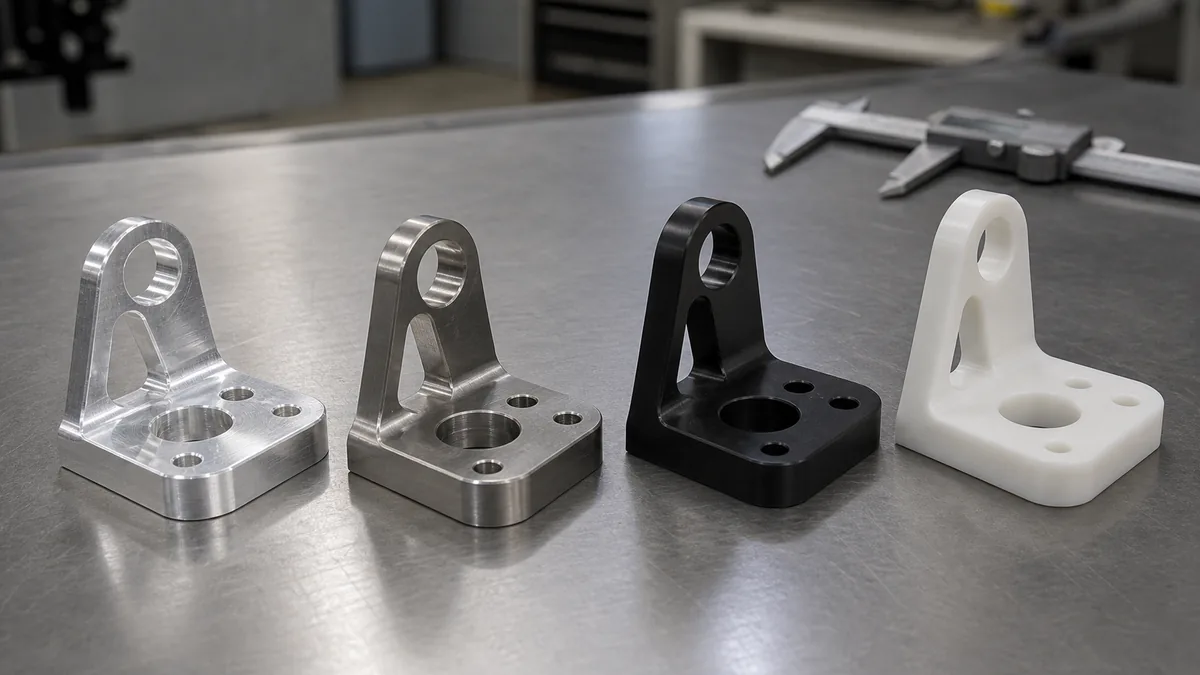
Metal and plastic CNC parts can both be precise, but they fail for different reasons. Metal is often chosen for strength, stiffness, heat, and durability. Plastic may be better for weight reduction, electrical insulation, chemical exposure, low friction, or corrosion avoidance. The right choice depends less on the material category and more on the load, environment, tolerance, finish, and assembly conditions the part must survive.
Start With the Failure Mode You Need to Avoid
The best material choice starts with the part’s most serious failure mode. A bracket may fail by bending, a guide may fail by wear, a spacer may fail by creep, and an enclosure may fail by corrosion or cosmetic damage. If the failure mode is unclear, the RFQ will usually drift toward the buyer’s familiar material rather than the best material.
For metal parts, common decision drivers include stiffness, thread strength, impact resistance, thermal stability, wear surface durability, and finish compatibility. For plastic parts, common drivers include weight, corrosion resistance, chemical compatibility, electrical insulation, friction behavior, noise reduction, and easier machining of some nonstructural features. Neither category is automatically better.
Before sending a quote, write one sentence that explains what the part must do: “This part locates a sensor in a washdown environment,” or “This plate carries a bearing load and must hold flatness after assembly.” That sentence will usually reveal whether metal or plastic deserves the first review.
Use a Decision Table Before Choosing the Material
A side-by-side decision table helps buyers compare the real tradeoffs instead of relying on broad rules such as “metal is stronger” or “plastic is cheaper.”
| Requirement | Metal CNC part direction | Plastic CNC part direction |
|---|---|---|
| High stiffness or structural load | Often a better first choice, especially for thin sections, threaded features, and rigid assemblies. | Possible when load is low or geometry can be thickened, but creep and deflection must be reviewed. |
| Weight reduction | Aluminum can reduce weight while keeping good stiffness. | Many plastics reduce weight further, but stiffness and fastening strategy need review. |
| Corrosion or chemical exposure | Requires alloy and finish selection, such as stainless steel, anodizing, plating, or coating. | Some plastics perform well in wet or chemical environments, but temperature and load still matter. |
| Electrical insulation | Usually needs coating, inserts, or design separation. | Often a strong reason to choose plastic if temperature and mechanical load are acceptable. |
| Tight tolerances and stable fits | Generally easier to hold in many mechanical assemblies. | Possible, but moisture, temperature, stress relaxation, and machining method must be considered. |
| Cosmetic surface finish | Many finishing options are available, including anodizing, bead blasting, plating, polishing, and coating. | Plastic appearance depends on stock, tool marks, material color, and whether polishing or texture is practical. |
This table does not replace engineering judgment. It gives the sourcing team a practical way to ask where the risk sits before choosing material purely by habit.
Compare Tolerance Stability, Not Just Machining Accuracy
Both metal and plastic can be machined accurately, but they do not hold dimensions the same way after machining. Metals are usually more stable under load and temperature, while many plastics are more sensitive to heat, moisture, clamping stress, and long-term creep.
If a plastic part has a tight bore, thin wall, long flat surface, or sliding fit, ask how it will behave during storage and use. Some plastics move after stress relief or environmental exposure. Others are easier to machine precisely but still need realistic tolerance expectations. The practical question is not “Can the supplier machine this dimension?” It is “Will the part still meet function when assembled and used?”
Metal parts have their own risks. Thin aluminum plates can warp if material is removed unevenly. Heat-treated steel may need grinding or secondary operations after hardening. Stainless steel can work harden during machining. The advantage of metal is not that it has no risk; it is that its dimensional behavior is often easier to predict for loaded mechanical parts.
For plastic-specific tolerance planning, CNCMAVEN’s article Pick the Plastic Before You Tighten the Tolerance gives a deeper look at material-first design.
Account for Fasteners, Inserts, and Wear Surfaces
Fastening strategy can decide the material before strength calculations do. Metal parts usually handle threads, press fits, dowels, and repeated assembly better than many plastics. Plastic parts may need threaded inserts, larger bosses, thicker walls, or lower torque limits.
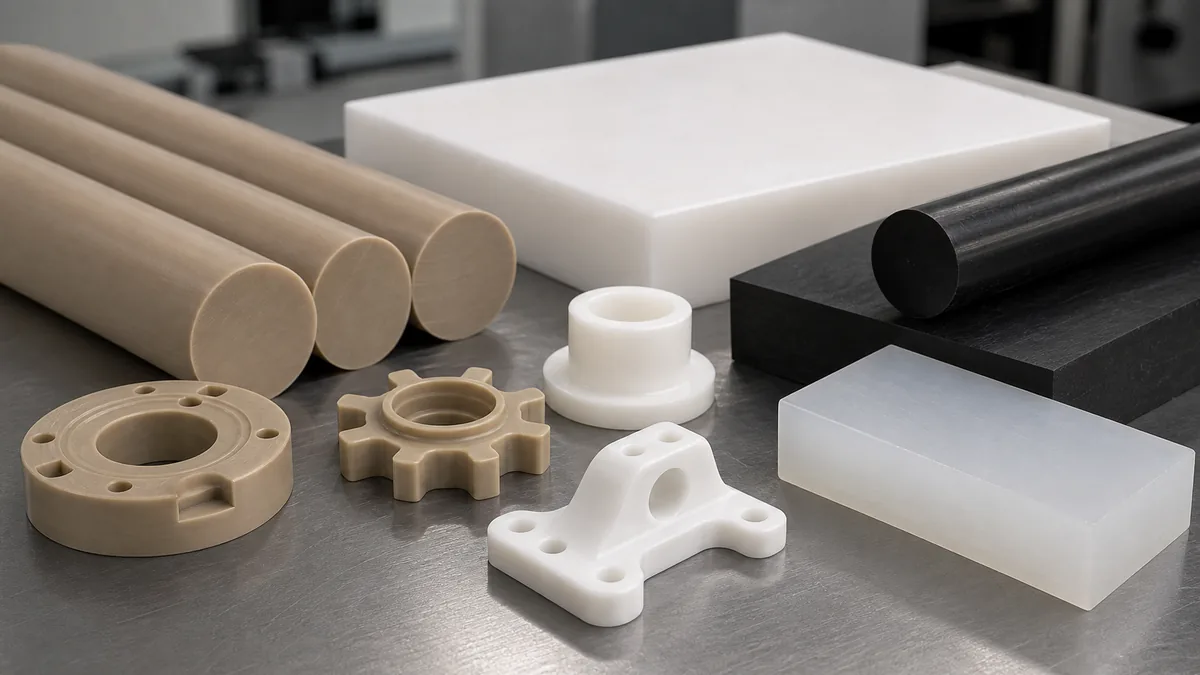
For wear surfaces, the answer depends on the pair of materials and the motion. Acetal, UHMW-PE, PTFE, and some filled plastics can perform well in sliding or low-friction applications. Hardened steel, anodized aluminum, or coated metal may be better when load, heat, or abrasion is high. Buyers should define the mating material, lubrication condition, speed, load, and duty cycle before asking a supplier to recommend a wear material.
When a part combines metal hardware and plastic geometry, specify insert locations, installation method, pull-out expectations, and inspection criteria. Do not leave inserts as a purchasing note after machining; they affect boss geometry, tool access, and quality control.
Match Material to Environment Before Finish
Environment can make a low-cost material expensive. Temperature, humidity, UV exposure, coolant, cleaning fluid, salt spray, and chemical contact can change the best choice. A metal part may need coating or passivation. A plastic part may need a different polymer grade because the first choice absorbs moisture, creeps under load, or loses stiffness at temperature.
If corrosion is the main concern, compare stainless steel, aluminum with a suitable finish, plated steel, and plastic alternatives. If chemical exposure is the main concern, identify the actual chemical, concentration, temperature, contact time, and cleaning process. “Chemical resistant” is not a complete specification.
For parts where HDPE is being considered, see when HDPE is the right plastic for CNC machining. For metal parts where appearance or protection is important, review bead blasting for CNC machined parts and the related finish guides before locking the drawing.
Estimate Cost by the Whole Part, Not Raw Material Alone
Material price is only one part of CNC cost. Machining time, stock availability, scrap risk, tolerance difficulty, inspection, secondary operations, finishing, inserts, packaging, and quality documentation can matter more than the raw stock price.
| Cost driver | Metal risk | Plastic risk |
|---|---|---|
| Machining time | Hard alloys, stainless steel, and deep features can increase cycle time. | Soft or flexible plastics may need careful fixturing and conservative cutting to avoid distortion. |
| Scrap risk | Warping, burrs, or post-finish dimensional issues can add cost. | Stress, heat, moisture, and holding marks can create rework or inspection disputes. |
| Secondary operations | Finishing, heat treatment, plating, and passivation may be required. | Inserts, polishing, stress relief, or special packaging may be required. |
| Inspection | Critical bores, flatness, threads, and finish thickness may need extra checks. | Inspection may need to account for conditioning, creep, or assembly fit. |
If reducing cost is important, compare design changes rather than only material substitutions. A slightly larger radius, relaxed hidden-surface finish, larger clearance, or simplified fastening feature can save more than switching from metal to plastic or plastic to metal.
Send a Material Selection RFQ That Allows Alternatives
A good RFQ tells the supplier what is fixed and what can be changed. If the material is mandatory, state the exact grade. If alternatives are allowed, explain the required function so the supplier can propose a practical option.
- State the target material and acceptable alternatives.
- Define load, temperature, chemical exposure, humidity, and wear conditions.
- Mark critical dimensions, threads, inserts, sealing surfaces, and cosmetic faces.
- State whether finish, color, or surface texture matters.
- Ask whether tolerances apply as-machined, after finishing, or after assembly.
- Request inspection notes for the features that control function.
This is also where a complete drawing package helps. CNCMAVEN’s guide on how to prepare a CNC machining quote package explains what suppliers need to price accurately.
Final Buying Advice
Choose metal or plastic CNC parts by function first: load, stiffness, environment, tolerance stability, fastening, wear, finish, and inspection. Metal is often safer for rigid mechanical structures and threaded features. Plastic can be the better choice for weight, insulation, corrosion avoidance, low friction, or chemical exposure. The strongest RFQ does not simply name a material; it explains why the material is being considered and which conditions the finished part must satisfy.
Are CNC plastic parts always cheaper than metal parts?
No. Plastic stock can be expensive, and difficult fixturing, inserts, tight tolerances, or special inspection can erase the raw material advantage.
When should I choose metal instead of plastic?
Choose metal first when the part needs high stiffness, strong threads, high load capacity, heat resistance, or predictable dimensional stability under mechanical stress.
When is plastic the better CNC material?
Plastic may be better when the part needs low weight, corrosion resistance, electrical insulation, low friction, chemical compatibility, or reduced noise, provided the design allows realistic tolerances and load limits.