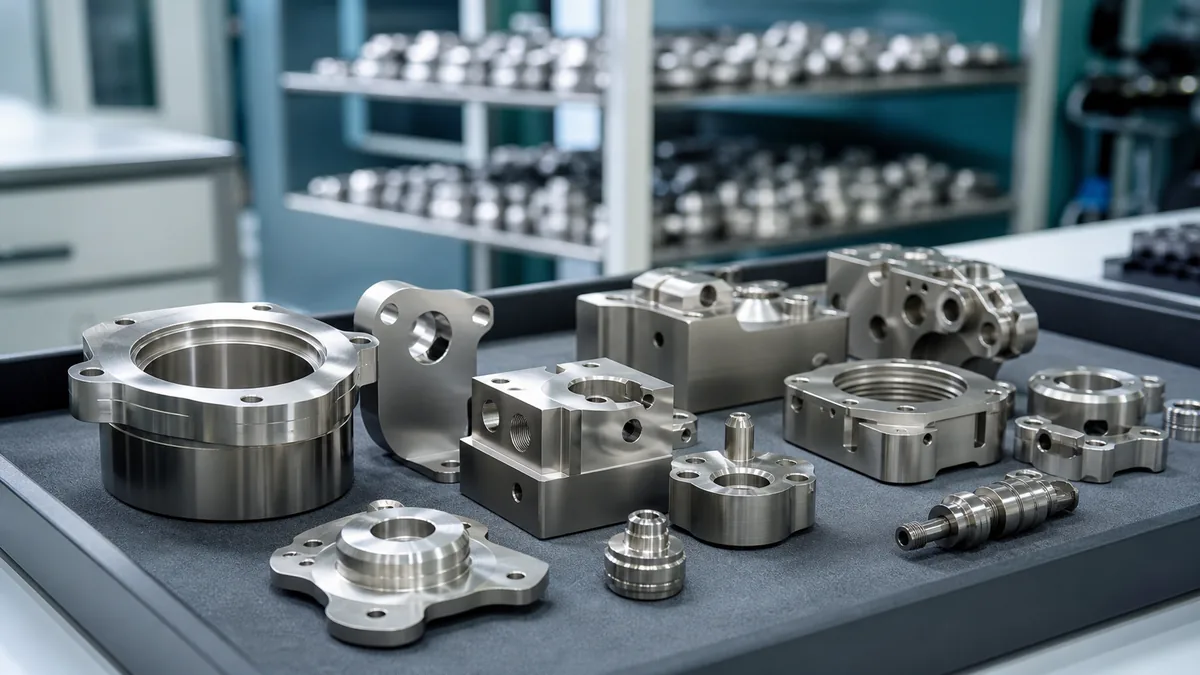
Electroless nickel plating is often chosen after CNC machining because it can protect complex metal parts without relying on line-of-sight electrical current. For buyers, that matters when a part has bores, slots, threaded holes, edges, or sealing surfaces that need more uniform coverage than many decorative coatings can provide. The finish can improve corrosion resistance, wear behavior, hardness, solderability in some applications, and dimensional consistency, but only when the specification is written clearly.
This article focuses on practical purchasing decisions: when electroless nickel makes sense, what to specify, and where the finish can create problems if the drawing is incomplete.
Why electroless nickel behaves differently from electroplating
Electroless nickel deposits nickel alloy through an autocatalytic chemical reaction rather than electrical current. Because the process does not need direct current density, it can coat recesses and internal features more uniformly than many electroplated finishes. That is useful for CNC machined manifolds, valve bodies, tooling plates, sensor housings, shafts, aluminum fixtures, and steel components with mixed external and internal surfaces.
The deposited layer is not just decorative. Depending on chemistry and post-treatment, electroless nickel can provide a hard, wear-resistant surface or a corrosion-resistant barrier. However, it still adds thickness. If a bore, thread, bearing seat, dowel hole, or sealing groove is already at final size before plating, the part may become too tight after finishing. Good drawings treat plating as part of the dimensional stack, not as a cosmetic afterthought.
Choose the phosphorus level to match the job
| Deposit type | Typical reason to choose it | Watch-outs | Common buyer note |
|---|---|---|---|
| Low phosphorus | Higher hardness and wear resistance | Lower corrosion resistance than high-phos systems | Use for sliding or wear surfaces when corrosion demand is moderate |
| Mid phosphorus | Balanced wear, corrosion, and general industrial use | Needs clear thickness and post-treatment callout | Often a practical default for machined parts |
| High phosphorus | Better corrosion resistance and more amorphous structure | May be softer before heat treatment | Use for chemical exposure, salt spray goals, or barrier protection |
Do not simply write “nickel plate” on the drawing. That phrase can be interpreted many ways. A useful note states electroless nickel, deposit thickness, phosphorus class if required, base material, masking areas, heat treatment if needed, appearance requirement, and inspection standard. For aluminum parts, pretreatment quality is especially important because poor surface activation can cause adhesion failures.
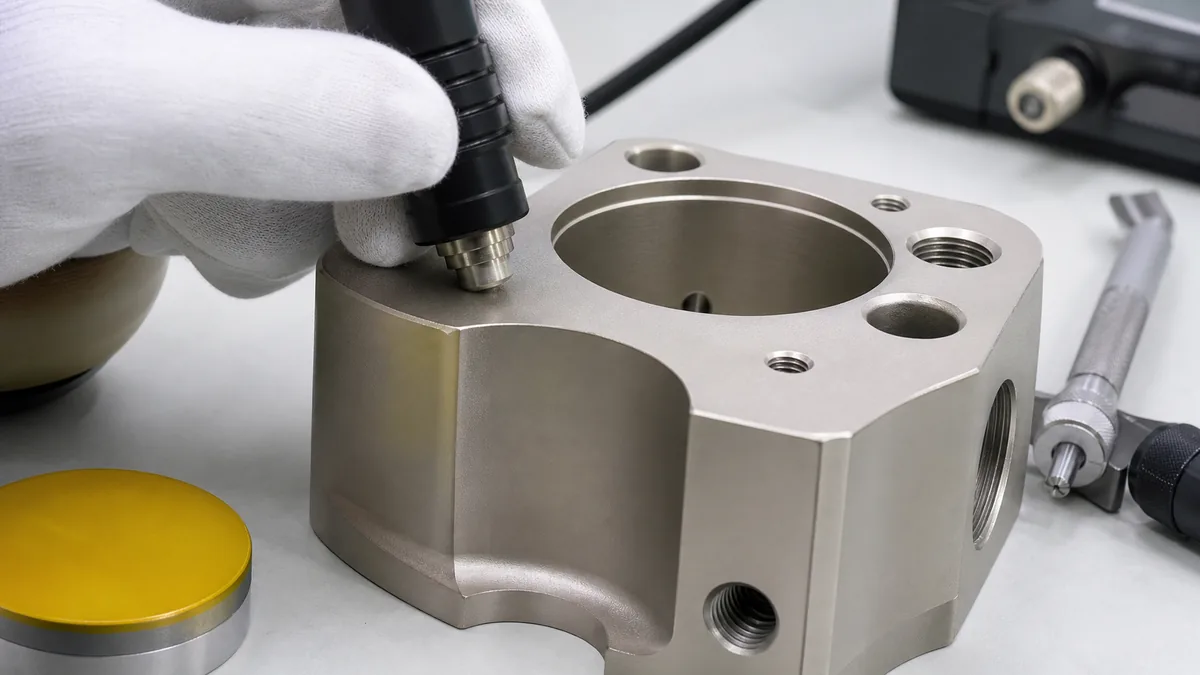
Specification checklist for CNC machined parts
- Thickness: Call out a practical range, not a vague minimum. Consider whether coating builds on both sides of a slot or bore.
- Critical dimensions: Mark dimensions that apply after plating and those that apply before plating.
- Masking: Identify threads, electrical contacts, press-fit holes, bearing seats, and ground surfaces that must not receive coating.
- Surface finish before plating: Poor machining marks, burrs, and embedded contamination can remain visible or cause coating defects.
- Heat treatment: Some deposits are heat treated to increase hardness; this can affect base material condition and final tolerance.
- Inspection: Define thickness test locations, adhesion expectations, corrosion testing if needed, and acceptable color variation.
Where electroless nickel can cause sourcing problems
The most common issue is tolerance closure. A nominal 25 micron coating adds material to surfaces. In a bore, that can reduce diameter by roughly twice the coating thickness if both sides are coated. Threads may feel tight, small holes may need reaming, and sliding fits may bind. The second issue is edge condition. Burrs and sharp edges can lead to poor adhesion or fragile coating. Deburring before plating is not optional for functional components.
Another issue is hidden contamination. Cutting fluids, heat-treat scale, polishing compound, and poor rinsing can create stains, pits, or adhesion failures. If the part will be used in a corrosion-sensitive environment, ask for sample coupons or first-article validation rather than discovering the problem after production. For assemblies, make sure plated parts still conduct, ground, seal, or bond as intended. Nickel can change electrical contact behavior and adhesive bonding results.
Comparison with other surface finishes
| Finish | Best use | Not ideal when | CNCMAVEN sourcing note |
|---|---|---|---|
| Electroless nickel | Uniform protection on complex metal parts | Very low cost cosmetic finish is the only goal | Good for bores, slots, manifolds, and wear/corrosion balance |
| Anodisasi | Aluminum corrosion protection and color options | Steel or mixed-metal parts need the same finish | Consider dimensional growth and sealing requirement |
| Bead blasting | Matte cosmetic texture before or instead of coating | Wear or corrosion protection is required by itself | Often used before anodizing or visual inspection |
| Spray painting | Large visible surfaces and color matching | Threads, bores, and precision features need uniform thickness | Masking and adhesion testing are important |
If the sourcing decision is still open, compare electroless nickel with CNCMAVEN’s layanan finishing permukaan, bead blasting, and spray painting. The right finish depends on function, not just appearance.
Inspection, handling, and packaging details buyers should not skip
Finished electroless nickel parts should be handled as functional components, not loose cosmetic hardware. Ask the supplier how parts will be racked, rinsed, dried, and packed so contact marks do not land on sealing faces or visible surfaces. For precision parts, define whether threaded holes need plug gauges after plating and whether bores need air gauging, pin gauges, or CMM checks after coating. If parts will be assembled immediately after receipt, request packaging that separates components and prevents nickel-on-nickel rubbing during transit.
First-article approval is also useful when the finish is new to the part family. A small pilot lot can confirm adhesion, thickness distribution, masking, color range, and assembly fit before the full production batch. That step is much cheaper than discovering that a coated bore, masked contact area, or sealing groove no longer works after hundreds of parts have been finished.
Final RFQ wording example
A practical drawing note might read: “Electroless nickel plate, mid-phosphorus, 12-18 microns, thickness applies after machining unless otherwise specified. Mask M6 threads, bearing bore, and electrical contact pad. Parts to be fully deburred before plating. Inspect coating thickness on face A and inside port B. No flaking, blistering, or visible staining.” Your exact note will differ, but this level of detail prevents most supplier assumptions.
Does electroless nickel plating change part dimensions?
Yes. It adds coating thickness to plated surfaces, so holes, threads, bearing seats, and close fits must be dimensioned with plating buildup in mind.
Is electroless nickel good for aluminum CNC parts?
It can be a strong option for aluminum when pretreatment is controlled. Adhesion, masking, thickness, and corrosion testing should be specified clearly for functional parts.