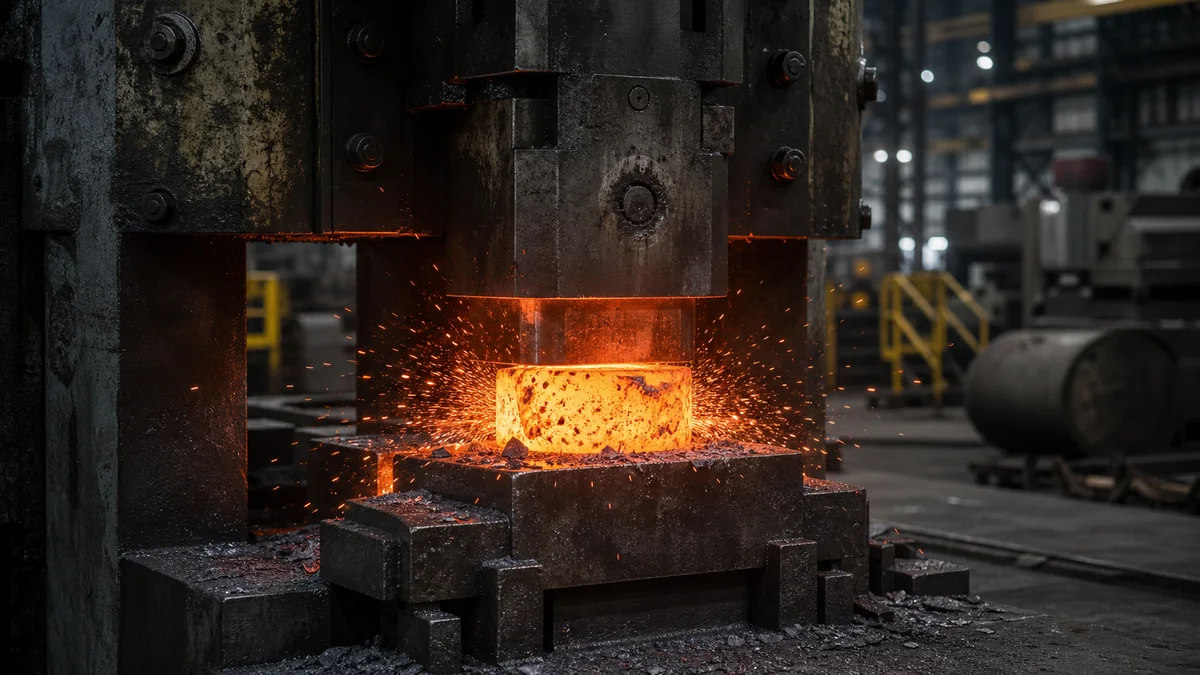
Drop forging shapes heated metal with repeated hammer or press force, creating parts that can be stronger and tougher than components cut entirely from stock. It is often considered for load-bearing parts where grain flow, fatigue resistance, and repeatable production matter.
The process still needs design discipline. Forged strength does not remove the need for draft, radii, machining allowance, die planning, heat treatment, and inspection datums.
What drop forging means
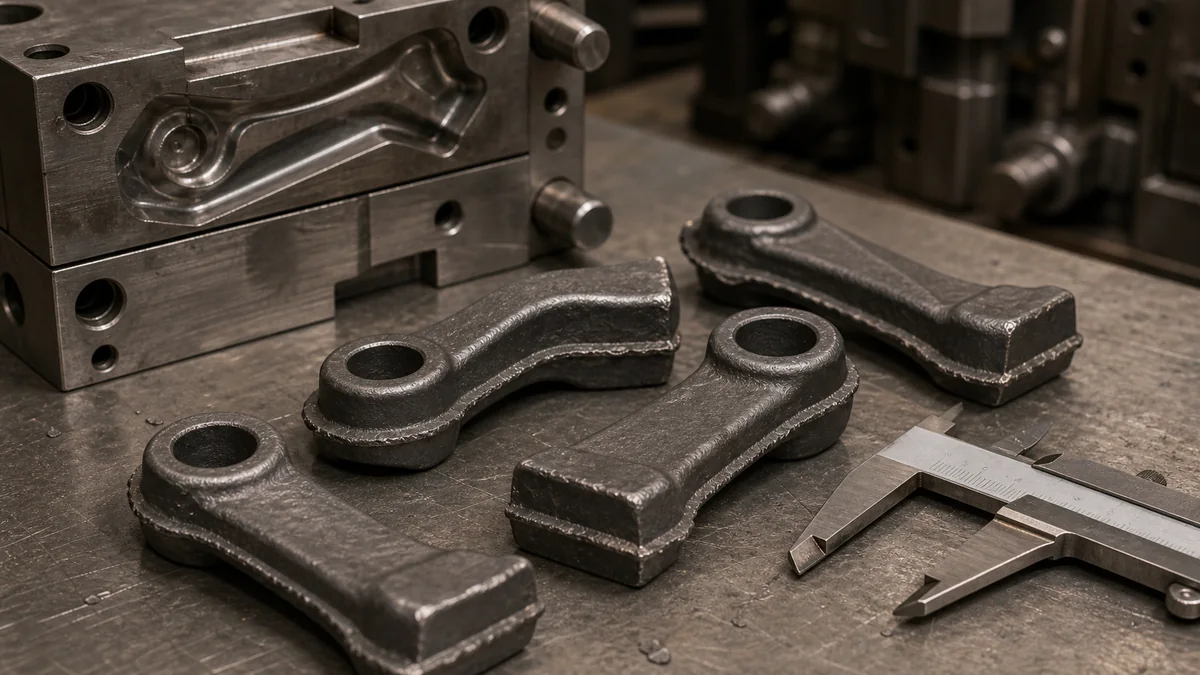
Drop forging uses a hammer or press to drive heated metal into dies. The force causes the metal to flow into the desired shape, and excess flash is trimmed away. Critical features such as holes, threads, sealing faces, or tight datums are often machined after forging.
Why forged parts can be stronger
Forged parts can be stronger because deformation can align grain flow with the part geometry and reduce certain casting-like defects. This is why forging is often considered for connecting rods, levers, brackets, shafts, hooks, gears, and other parts that see impact, fatigue, or high load.
| Decision factor | Drop forging advantage | Tradeoff to manage |
|---|---|---|
| Strength | Improved grain flow and toughness for load paths. | Alloy, temperature, and heat treatment still matter. |
| Repeatability | Closed dies can repeat near-net shapes at volume. | Tooling must be justified by quantity. |
| Material use | Near-net shape can reduce machining from billet. | Flash, trimming, and scale are part of the process. |
| Precision | Forging creates the blank shape efficiently. | CNC machining is needed for tight features. |
Open-die vs closed-die drop forging
Open-die forging shapes metal between relatively simple dies and is useful for larger, simpler, or lower-volume forms. Closed-die forging uses shaped dies that contain the metal flow more tightly and is better for repeatable near-net parts, but tooling cost and die design become more important.
CNCMAVEN’s CNC forging services can support forged blanks and post-forging machining when parts need both forged strength and precision interfaces.
Design rules for drop forged parts
- Add draft: Draft helps the forged part release from the die and reduces tooling problems.
- Use generous radii: Sharp corners restrict metal flow and increase die stress.
- Avoid deep undercuts: Forging dies need practical part removal and metal flow.
- Leave machining allowance: Bores, threads, flat sealing faces, and precision datums usually need CNC machining after forging.
- Plan grain flow: The strongest design aligns forged flow with the part’s main load direction.
Where drop forging may not make sense
Drop forging may not make sense for very low quantities, highly intricate internal cavities, parts with severe undercuts, or designs that will change repeatedly. In those cases, CNC machining from billet, fabrication, casting, or sheet metal forming may be faster and less expensive.
If the part is actually a formed sheet component rather than a solid forged blank, compare it with fabrikasi lembaran logam and the guide to sheet metal forming.
FAQ
Is drop forging stronger than casting?
For many load-bearing applications, forging can offer better toughness and grain flow than casting. The exact comparison depends on alloy, heat treatment, geometry, and quality control.
Does a drop forged part still need machining?
Usually yes. Forging creates the strong near-net blank, while CNC machining finishes holes, threads, datums, sealing faces, and other precision features.
What is the difference between drop forging and press forging?
Drop forging uses impact from a hammer or similar equipment, while press forging applies force more gradually through a press. Both can produce strong forged parts when the process is matched to the material and geometry.
Conclusion
Drop forging is a strong candidate for repeat load-bearing metal parts that benefit from grain flow and toughness. The best results come from treating forging and CNC machining as a combined manufacturing plan: forge the strength and general shape, then machine the critical interfaces.