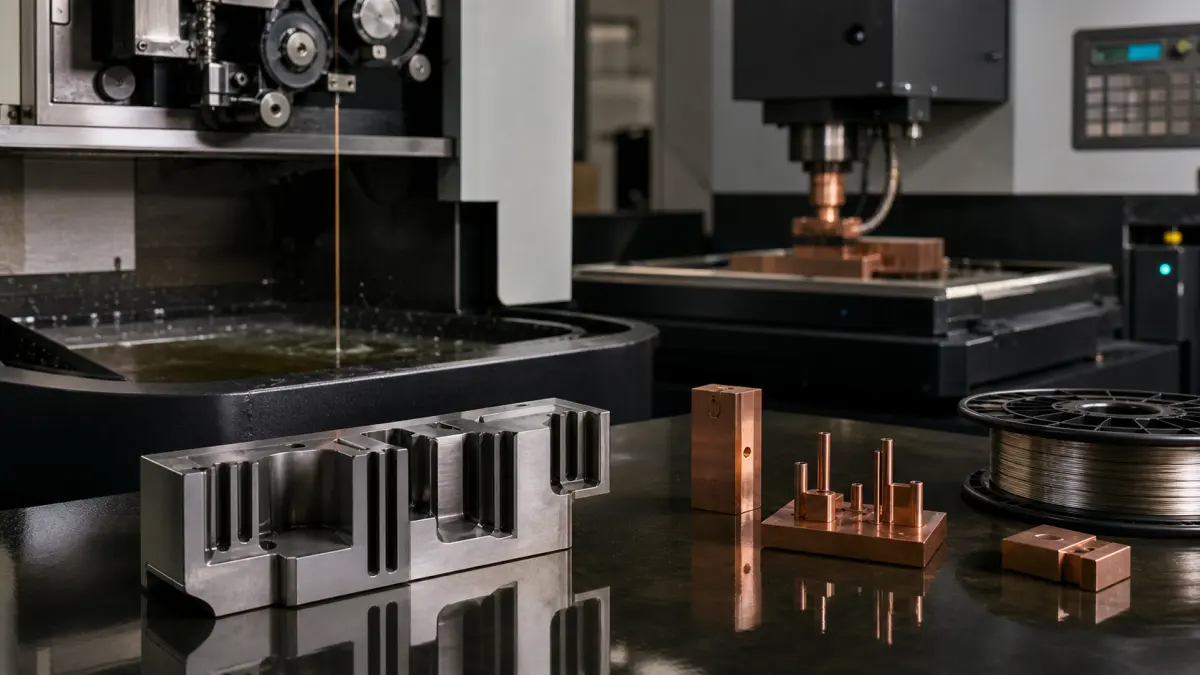
Electrical discharge machining, or EDM, is useful when the feature is too hard, too narrow, too deep, or too sharp for conventional cutting tools to handle economically. It is not a replacement for CNC milling on every metal part. Buyers should use EDM when the geometry or material justifies the slower process, extra setup, and inspection requirements.
Choose EDM when tool contact becomes the main risk
EDM removes conductive material with controlled electrical discharges instead of cutting force from a rotating tool. That makes it valuable for hardened steel, tight internal corners, deep narrow slots, small details, and features where tool deflection would create quality risk.
Conventional CNC milling is usually faster and more flexible for open pockets, broad surfaces, drilled holes, and features that can accept practical cutter radii. The problem begins when the drawing demands a sharp inside corner, a narrow slot deeper than a stable end mill can reach, or a hardened part that would wear cutting tools aggressively. In those cases, EDM may reduce the risk of chatter, broken tools, burr-heavy edges, or repeated rework.
EDM still has limits. It only works on electrically conductive materials. It can be slower than milling. It may leave a recast layer or require additional finishing depending on the application. Wire EDM also needs a path for the wire to pass through, while sinker EDM requires an electrode shaped for the cavity or detail. These tradeoffs belong in the sourcing discussion before the quote is approved.
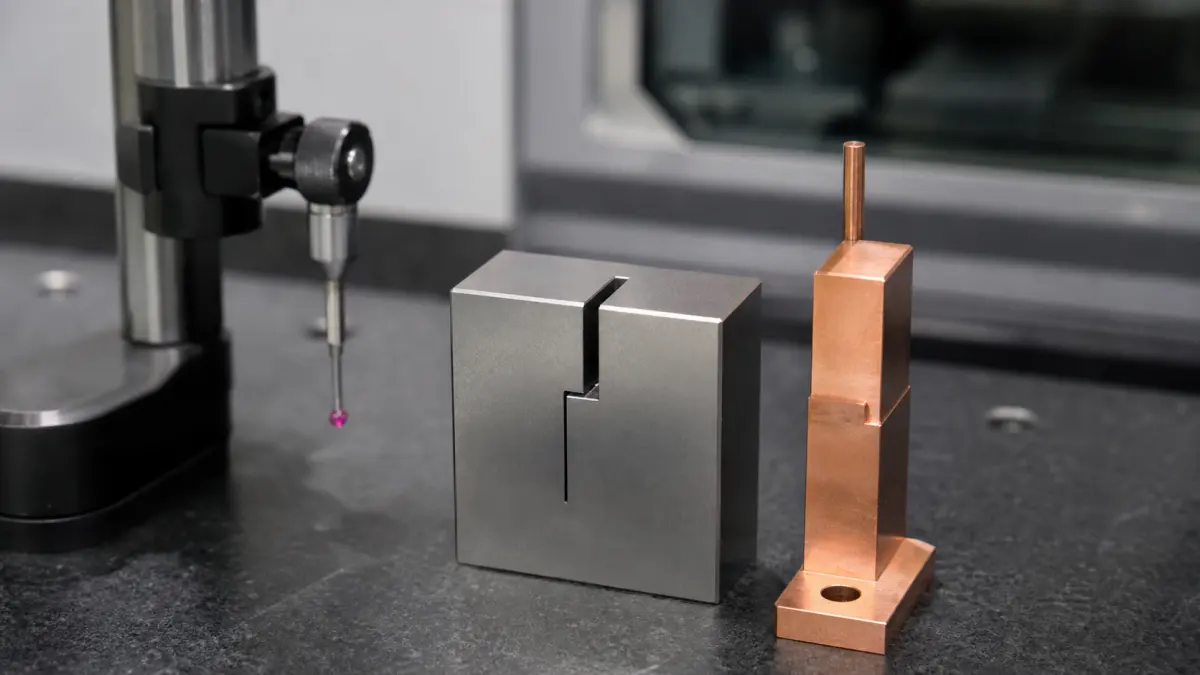
Use this decision matrix before changing the manufacturing route
The fastest decision is not “EDM or CNC” in general. It is which process fits the specific feature, material state, and tolerance risk.
| Feature or condition | Best starting process | Why | Buyer note |
|---|---|---|---|
| Open pocket with reasonable corner radius | CNC milling | Efficient material removal and flexible toolpaths. | Increase corner radii where possible to avoid unnecessary EDM. |
| Through slot with tight width and straight walls | Wire EDM | The wire can cut precise profiles through conductive material. | Confirm start hole, slot width, cut length, and edge condition. |
| Blind cavity with sharp internal detail | Sinker EDM | A shaped electrode can form details that a rotating cutter cannot reach. | Expect electrode cost and discuss allowable corner radii or polish. |
| Hardened tool steel after heat treatment | EDM or grinding, depending on geometry | Hardness can make milling difficult or unstable. | State hardness condition and whether the feature is before or after heat treatment. |
| Large flat face or simple drilled pattern | CNC milling/drilling | EDM would usually add cost without improving function. | Do not specify EDM just because the material is hard if standard machining works. |
This matrix helps prevent two common mistakes: forcing milling into geometry it cannot control, or specifying EDM for features that a shop could machine more efficiently with standard tools.
Wire EDM fits through-features and profile accuracy
Wire EDM is strongest when the wire can pass through the workpiece and follow a precise profile. It is often considered for narrow slots, punches, dies, extrusion tooling, precision plates, gears, and conductive components with intricate outlines.
The buyer should confirm whether the feature is a through cut, whether a start hole is acceptable, and how the cut edge will be used. A wire cut slot for clearance may have different requirements from a functional sealing edge or a sliding interface. If the feature is part of a larger CNC machined component, the order of operations also matters. Milling may create datum surfaces first, heat treatment may follow, and EDM may finish the high-risk details afterward.
CNCMAVEN already covers the process in more detail in the wire EDM machining guide. For sourcing, use that process knowledge to ask better questions: where will the wire start, which datum controls the cut, what edge condition is acceptable, and how will the cut be inspected?
Sinker EDM fits blind cavities and shaped details
Sinker EDM is better suited for blind cavities, ribs, sharp details, and shapes made by a formed electrode. The electrode can be copper or graphite depending on the application, and it wears during the process, so electrode design becomes part of the manufacturing plan.
This process can make sense for mold details, keyways, small internal features, tooling inserts, and details that cannot be reached with a rotating cutter. It is less attractive when the feature is open and easy to mill, because electrode design and EDM time can add cost.
For buyers, the key point is to identify which surfaces are functional. A blind cavity may need a certain floor finish, corner condition, or wall straightness. If the drawing simply demands a sharp internal corner without explaining why, the supplier may quote EDM when a small radius would work just as well. If the sharp corner is required for an insert, seal, or tool clearance, say so. That context helps the supplier decide whether to machine, EDM, or propose a design change.
Specification details decide whether EDM is worth it
EDM should be specified around feature function, not as a vague process preference. A good RFQ tells the supplier why the detail is difficult and what must be controlled after machining.
- Material and condition: state the alloy and whether the part is annealed, pre-hardened, hardened, or heat treated after rough machining.
- Feature type: identify through slots, blind cavities, sharp internal details, keyways, fine profiles, or deep narrow geometry.
- Datum scheme: define how EDM features relate to milled faces, bores, or assembly references.
- Edge condition: specify whether burrs, recast layer concerns, sharp edges, or break edges matter for function.
- Surface requirement: clarify whether as-EDM finish is acceptable or whether polishing, grinding, or additional finishing is needed.
- Inspection method: ask how slot width, profile, corner condition, and location will be checked.
If the rest of the component is conventionally machined, include EDM requirements in the same quote package rather than treating them as a separate afterthought. CNCMAVEN’s CAD file guide for CNC RFQs is a useful companion because datum, model, and drawing information must agree.
Cost risk usually comes from hidden process changes
EDM cost increases when the drawing hides the reason for the detail. A small inside radius change can move a feature from EDM to milling. A material hardness change can move it back to EDM. A blind cavity may need multiple electrodes if the geometry is complex. A through slot may need start holes, wire threading time, and inspection steps that were not obvious from a screenshot.
| Cost driver | What creates it | How to control it |
|---|---|---|
| Electrode work | Sinker EDM details require designed and machined electrodes. | Allow practical radii or simplify blind details where function permits. |
| Slow cutting time | Fine finish, thick material, or precise profiles can require slower EDM passes. | Separate functional surfaces from non-critical surfaces. |
| Operation sequencing | Milling, heat treatment, grinding, and EDM may need a controlled order. | State heat treatment timing and critical datums early. |
| Inspection complexity | Narrow slots and internal corners may need special gauges or CMM access. | Define the acceptance method before production. |
Inspection should confirm the feature, not just the process
A part is not acceptable because it was EDM cut. It is acceptable when the feature meets the functional requirement. Inspection should verify location, width, profile, edge condition, and relation to datums.
For wire EDM slots, ask whether the slot width and straightness will be measured at multiple points. For sinker EDM cavities, ask how the cavity depth, wall condition, and electrode-shaped details will be verified. For hardened parts, confirm whether inspection happens after all heat treatment and finishing operations. If a surface will be polished after EDM, the drawing should clarify which dimension is controlled before and after finishing.
Conclusion
EDM is the right choice when the material or geometry makes conventional cutting tools risky, not when a part simply looks difficult. Use CNC milling for accessible features with practical radii. Use wire EDM for conductive through-features and precise profiles. Use sinker EDM for blind cavities and shaped details. The better the RFQ explains material condition, datums, edge requirements, and inspection, the easier it is for a supplier to choose the process that protects quality without adding unnecessary cost.