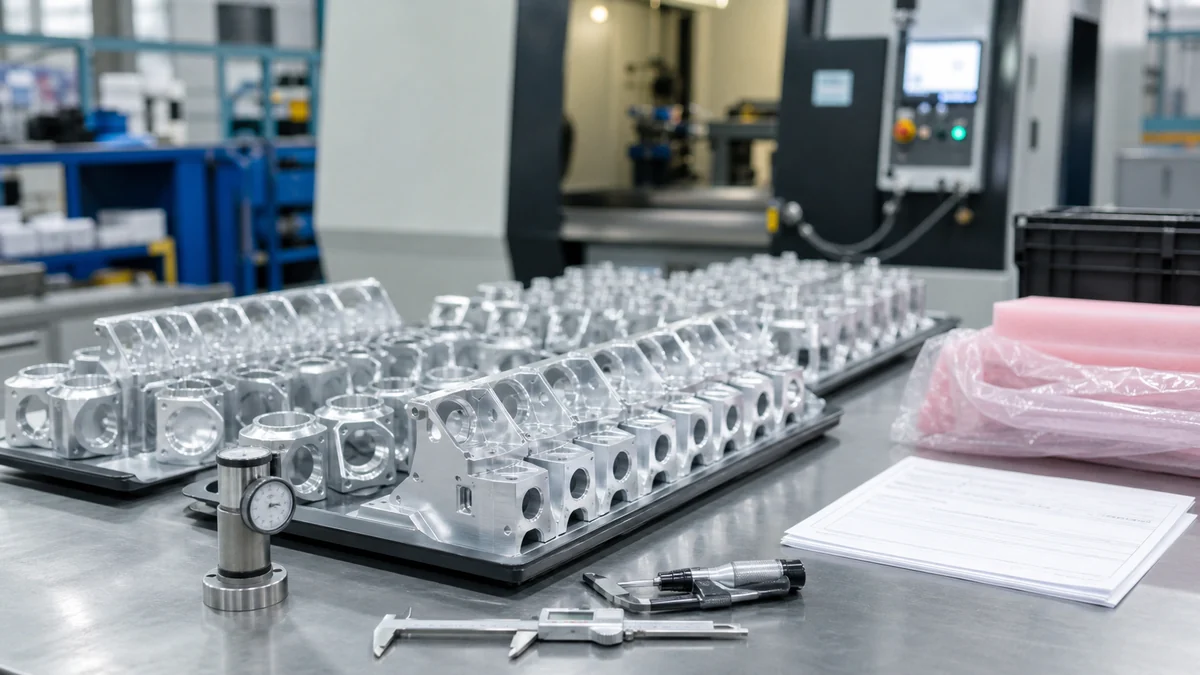
A CNC prototype can prove that a design works, but it does not automatically prove that the part is ready for repeat production. The risk changes when the order moves from two samples to 50, 200, or 1000 pieces. Small drawing gaps become repeated defects. Vague finishes become sorting work. Uncontrolled revisions become scrap.
This guide shows what buyers should lock down before moving CNC machined parts from prototype to volume production.
Decide what the prototype actually proved
Before placing a production batch, separate what the prototype confirmed from what it did not confirm. A prototype may prove assembly fit but not cycle time. It may prove material strength but not cosmetic consistency. It may prove a thread works but not that the hole position can be held across multiple setups. The production plan should close those gaps before quantity increases.
| Prototype result | Production question still open | Buyer action |
|---|---|---|
| Part assembled once | Will every batch hold the same fit? | Freeze datums, tolerances, and inspection dimensions. |
| Material passed test | Is the same grade and condition available for repeat orders? | Specify grade, certificate needs, and allowed substitutions. |
| Finish looked acceptable | Which faces are cosmetic or functional? | Mark visible faces, roughness needs, coating, deburring, and packaging. |
| Supplier made a sample | Can the process be fixtured and repeated? | Ask about setup strategy, critical features, and batch inspection. |
| Drawing was incomplete | Will the supplier guess the same way next time? | Update the drawing before ordering quantity. |
Freeze the drawing before increasing quantity
A production-ready CNC drawing does not need to over-dimension every feature. It needs to tell the supplier which features control function, what general tolerance applies elsewhere, what material and finish are required, and how the part will be inspected. If the team still expects changes, call the order a pilot build rather than a production batch.
Use consistent revision names across the STEP file, drawing, purchase order, and email thread. A small mismatch can cause the wrong version to be machined repeatedly. If the part includes threaded holes, inserts, press fits, sealing faces, or mating datums, those details should be on the drawing rather than hidden in a message.
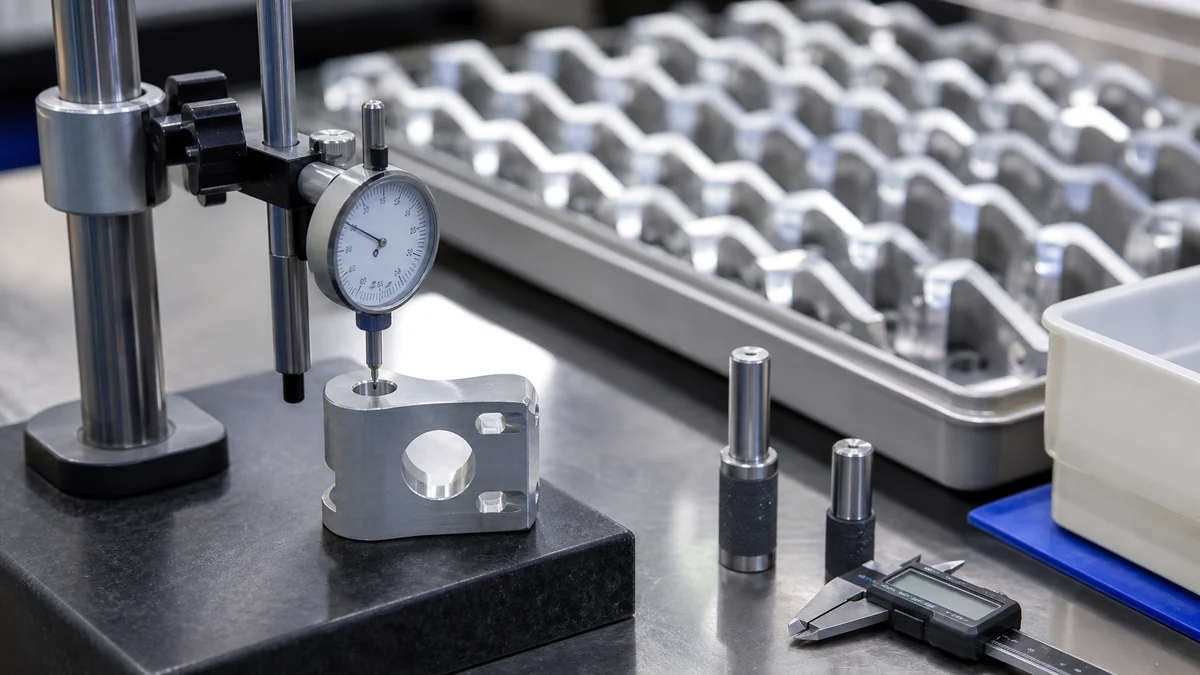
Build a simple control plan for repeat CNC orders
A control plan does not have to be complicated. For many low-volume CNC parts, it can be a short list of features that must be checked, how they are measured, and how often they are checked. The plan should focus on functional risk instead of checking every dimension on every part.
| Control item | Typical check | Why it matters |
|---|---|---|
| Critical hole pattern | First article plus sampling by lot. | Controls assembly fit and avoids repeated misalignment. |
| Bearing bore or shaft diameter | Direct measurement with suitable gauge or CMM where needed. | Controls motion, clearance, and service life. |
| Flat sealing face | Flatness or surface finish check if functional. | Prevents leaks, rocking, or uneven clamp load. |
| Threaded features | Thread gauge and depth check. | Avoids assembly failure after finishing or deburring. |
| Cosmetic faces | Visual standard and packaging review. | Prevents avoidable rework when visible surfaces matter. |
Production DFM is different from prototype DFM
Prototype DFM often asks whether the part can be made once. Production DFM asks whether it can be made consistently without unnecessary cost or sorting. Deep pockets, thin walls, long slender features, tight flatness, and difficult internal corners may be acceptable for one prototype but expensive for a batch. A small change to corner radius, stock size, setup direction, or noncritical tolerance may improve repeatability without changing product function.
- Relax noncritical tolerances before they become production habits.
- Review whether one setup can control the most important datums.
- Separate cosmetic finish from functional roughness requirements.
- Confirm whether coating thickness affects holes, threads, or fits.
- Plan packaging for finished parts, not only machining.
- Keep a deviation log if the pilot batch uses temporary shortcuts.
When CNC remains the right production process
CNC machining remains a strong production process when quantities are moderate, geometry changes are possible, material properties matter, tolerances are tight, or tooling investment for molding, casting, or stamping is not justified. It may stop being the best choice when annual volume is high, geometry is stable, and a near-net process can reduce unit cost after tooling. The decision should compare total risk, not only unit price.
CNCMAVEN’s CNC machining services can support prototypes and repeat CNC batches. Before release, review the DFM considerations for CNC milling and align drawing tolerances with ISO 2768 CNC machining tolerances where appropriate.
Use a pilot batch before committing to repeat volume
A pilot batch is useful when the design is mostly frozen but the team still needs to prove repeatability. It should be large enough to reveal setup, deburring, finishing, inspection, and packaging issues that one or two prototypes cannot show. The pilot order should use the intended material, revision, finish, and inspection plan unless a deviation is written down.
After the pilot batch, review rejects and supplier questions before placing the next order. If most problems come from unclear tolerances, fix the drawing. If problems come from burrs or finish variation, mark the affected faces and update the acceptance standard. If problems come from long cycle time, review noncritical features, corner radii, stock size, and setup strategy before asking only for a lower price.
What to include in a repeat-order package
Repeat CNC production works best when the buyer sends the same controlled package each time. The package should include the released STEP file, PDF drawing, revision history, quantity, delivery schedule, material and finish requirements, inspection requirements, packaging expectations, and any approved deviations from previous lots. If the part was changed after a pilot run, show what changed and why.
| Repeat-order item | What it should clarify | Risk if missing |
|---|---|---|
| Released files | STEP model and PDF drawing with the same revision. | Wrong revision or obsolete geometry may be machined. |
| Inspection plan | First article, sampling, CMM, or key dimension report. | Functional features may not be checked consistently. |
| Finish and packaging | Coating, visible faces, burr limits, and packing method. | Parts can pass dimensions but fail cosmetic or handling expectations. |
| Approved deviations | Temporary changes accepted during pilot or urgent orders. | A temporary shortcut may become the uncontrolled production standard. |
This level of control does not slow the process down; it reduces repeated clarification. The supplier can quote and machine faster when the risk is visible and the acceptance standard is stable.
FAQ
What quantity counts as CNC volume production?
There is no fixed cutoff. In sourcing, the risk usually changes when a buyer moves from prototypes to repeat batches such as tens, hundreds, or low thousands of parts.
Should every dimension be inspected in a CNC production batch?
Usually no. Inspection should focus on critical features, first articles, and sampling plans that match the part risk. Checking every dimension on every part can add cost without improving the right controls.
When should CNC production move to molding or casting?
Consider another process when the design is stable, annual volume is high, and tooling cost can be justified by lower unit cost or better process fit.