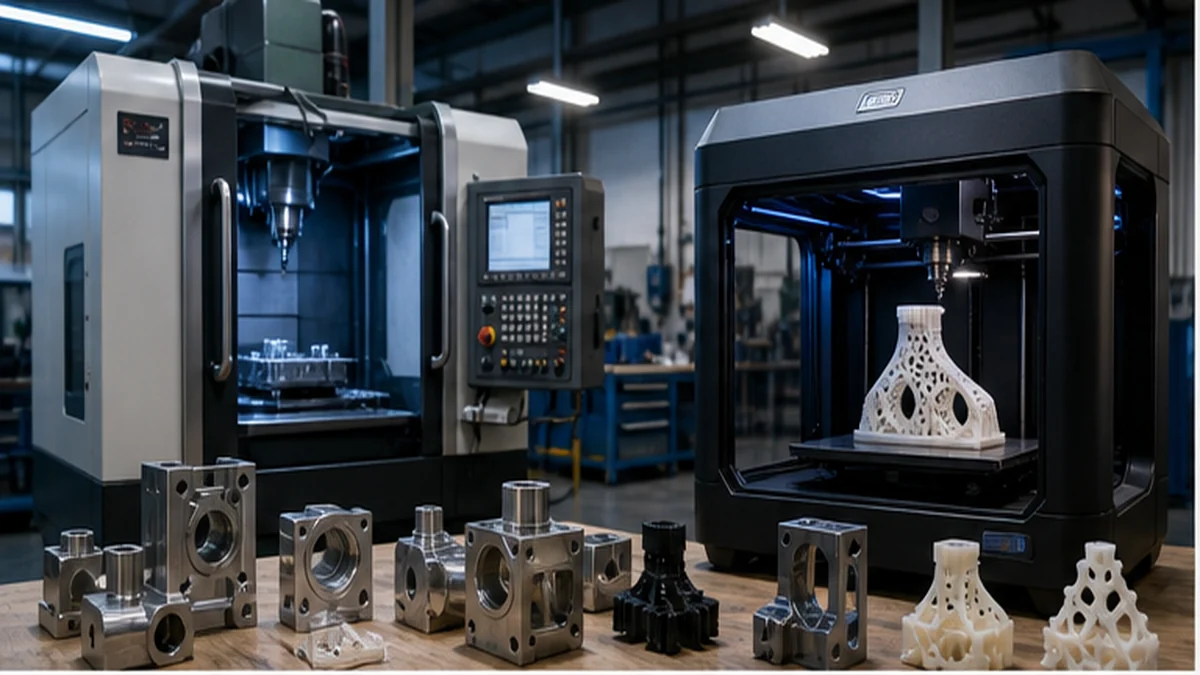
CNC machining and 3D printing can both produce prototype parts, but they answer different manufacturing questions. If the part must behave like the final metal or plastic component, hold tighter features, or prove assembly fit, CNC machining is often the safer test. If the team needs a quick shape study or a complex internal form, 3D printing may move faster.
Start with the question the prototype must answer
The right process depends on what the next prototype needs to prove. Use 3D printing when the team mainly needs to check shape, ergonomics, packaging, or early layout. Use CNC machining when the part must test real material behavior, thread strength, sealing faces, bearing fits, heat transfer, or dimensional accuracy. A printed part can look correct and still fail to represent the final product if stiffness, surface finish, or tolerance stack-up matters.
| Decision factor | CNC machining is usually stronger when | 3D printing is usually stronger when |
|---|---|---|
| Material behavior | The part must use aluminum, stainless steel, brass, copper, or a production-grade engineering plastic. | The part is for concept validation and approximate mechanical behavior is acceptable. |
| Tolerance risk | Mating faces, bores, threads, and sealing features must be measured against a drawing. | The geometry is complex but functional tolerances are not yet final. |
| Surface finish | The prototype needs machined, bead-blasted, anodized, plated, or polished surfaces. | Layer lines or post-processed printed surfaces are acceptable for the test. |
| Geometry | The design can be reached by milling, turning, drilling, EDM, or secondary operations. | Internal channels, lattice structures, or organic shapes are more important than finish. |
| Quantity | A small batch of functional parts is needed for testing or pilot builds. | One or two visual or fit-check models are enough. |
Material choice is where the processes separate
CNC machining starts from real stock, so the part can be made from the intended alloy or plastic. That matters for threads, clips, wear surfaces, thermal conductivity, chemical resistance, and stiffness. 3D printing offers useful material options, but the printed grade, build orientation, and post-processing route may not match the final production material. For buyer decisions, the key question is whether material behavior is part of the test or only the shape is being reviewed.
Tolerance and surface finish can change the decision
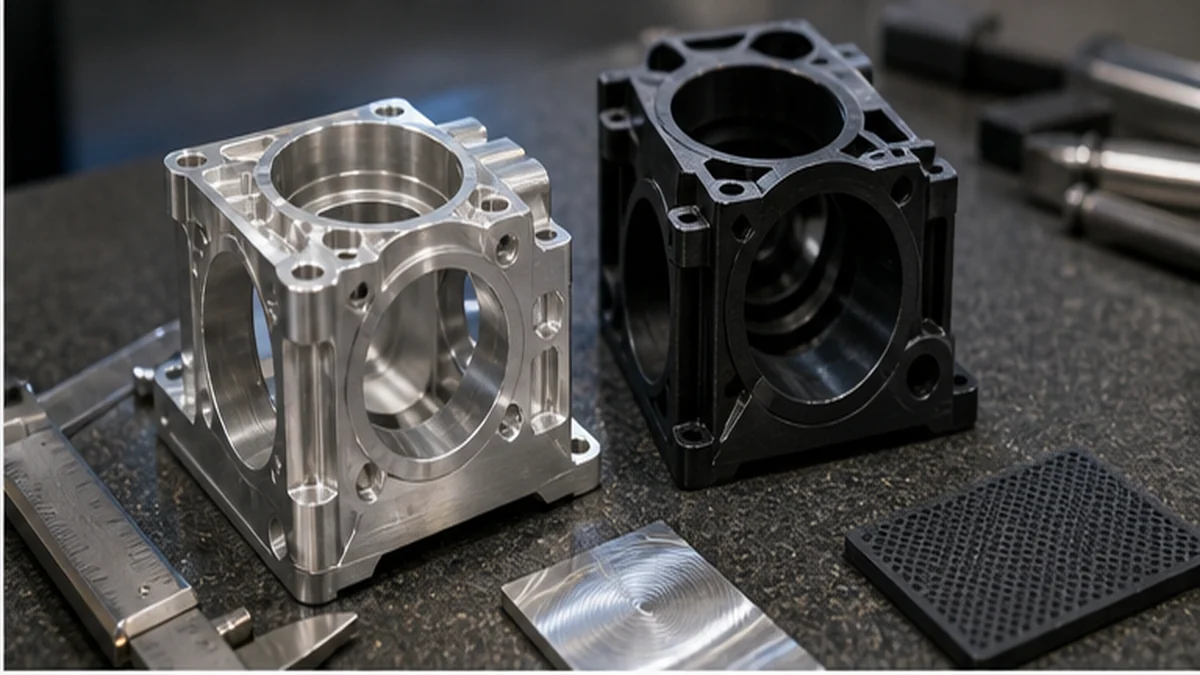
CNC machining is usually easier to specify when the drawing already includes controlled dimensions, datums, surface finish notes, and threads. A machined prototype can be inspected with calipers, gauges, CMM, or functional checks using the same logic as later production. 3D printing can still support fit checks, but fine holes, flat sealing faces, snap features, and thin walls may need different allowances from a machined part.
Use both processes when the project stage changes
A strong development plan often uses both processes instead of treating them as competitors. Early prints help a team find ergonomic or packaging problems quickly. CNC prototypes then validate the material, tolerance, threads, and assembly behavior before production tooling or larger-volume machining. This reduces the risk of spending CNC budget on a shape that has not been reviewed, while also avoiding false confidence from a printed part that cannot represent the final material.
RFQ checklist before choosing a supplier
- Send a STEP file and a controlled 2D drawing if dimensions matter.
- Mark which features are functional and which are only cosmetic.
- State whether the prototype must use final production material.
- List expected surface finish, coating, or post-processing requirements.
- Explain the test goal: visual review, fit check, load test, thermal test, pilot assembly, or customer sample.
Cost and timing tradeoffs to discuss before ordering
Cost comparison should include more than the unit price. A printed prototype may be cheaper for a single shape model, but it may not answer whether a tapped hole will survive assembly, whether a bearing bore will hold tolerance, or whether a sealing face will need machining later. A CNC prototype may cost more at the first order, but it can reduce risk when the next decision depends on production material, measured dimensions, or a finish that customers will see.
Lead time has the same issue. Printing can be fast when the part is simple to queue and does not need demanding post-processing. CNC machining can be faster than expected when material is available, tolerances are realistic, and the drawing makes inspection clear. The RFQ should state what the prototype must prove so the supplier can recommend the process that reduces the most risk, not only the one that looks fastest at first glance.
For mixed-process projects, keep revision notes separate for printed and machined parts. A feature that works in a printed model may need a larger radius, different wall thickness, or a different fastener strategy once it becomes a machined metal or plastic component.
This keeps prototype feedback traceable.
FAQ
Is CNC machining better than 3D printing?
Not always. CNC machining is better when real material behavior, tighter tolerances, threads, and functional surfaces matter. 3D printing is better for fast shape studies and complex forms.
Can a 3D printed prototype replace a CNC prototype?
It can replace a CNC prototype only when the test does not depend on final material, surface finish, or tight dimensional behavior.
When should a product team use both?
Use 3D printing for early shape and assembly learning, then use CNC machining for functional validation before production tooling or pilot builds.
Conclusion
Choose CNC machining or 3D printing by the risk you need to reduce. If the risk is shape, speed, or internal geometry, printing may be enough. If the risk is fit, finish, material performance, or inspection, CNC machining gives a more reliable path to production decisions.