Carbon steel is often the practical choice when a CNC machined part needs strength, stiffness, weldability, and reasonable material cost. It is used for brackets, shafts, pins, housings, tooling plates, fixtures, machine components, and structural parts that do not require stainless corrosion resistance. The challenge is that “carbon steel” is not one material. Grade, heat-treatment condition, sulfur content, surface condition, and finishing plan all affect machinability and final performance.
This guide explains how to specify carbon steel CNC parts so the shop can quote accurately and machine reliably. It is written for buyers who need strong parts without overpaying for unnecessary alloy content or discovering too late that the finish, tolerance, or heat treatment changes the process route.
When Carbon Steel Is the Right Material
Carbon steel is a good fit when strength, stiffness, wear resistance, or weldability matter more than weight reduction or natural corrosion resistance. Compared with aluminum, it is heavier and generally slower to machine, but it can provide better load capacity and lower raw material cost for many industrial components. Compared with stainless steel, carbon steel is usually easier to source and less expensive, but it needs protective finishing if rust is a concern.
Common applications include fixture plates, machine frames, couplings, shafts, gears, pins, hydraulic blocks, mounting brackets, and wear components. If the part will operate outdoors, in humid packaging, or near chemicals, the buyer should plan coating, black oxide, plating, oiling, or a stainless alternative. If the part must be welded after machining, tell the supplier before grade selection because free-machining grades may not be the best weldment choice.
| Carbon steel choice | Typical reason to use it | Specification caution |
|---|---|---|
| Low-carbon steel such as 1018 or similar mild steel | Good general-purpose strength, weldability, and lower cost | Needs coating or oil for corrosion protection. |
| Medium-carbon steel such as 1045 | Higher strength and wear resistance than mild steel | Machining forces and heat-treatment planning become more important. |
| Free-machining steel such as 12L14 or 1215 | Faster cycle time and better chip breaking | Not ideal for every strength, impact, plating, or welding requirement. |
| Pre-hardened or heat-treated steel | Improved mechanical performance with less post-machining movement | Tool wear, setup rigidity, and grinding/finishing allowance may affect price. |
Grade Selection Changes Machining Behavior
Supplier references often emphasize that steel grades behave differently at the machine. Mild steels can be gummy and may form long chips if tooling and feeds are not controlled. Free-machining grades break chips more easily because of sulfur or other additions, which can reduce cycle time. Medium-carbon steels provide better strength but can generate higher cutting forces and faster tool wear. Heat-treated steels require more conservative cutting and may need finishing passes, grinding, or EDM for certain features.
The safest RFQ language is specific. Instead of writing “steel,” state the grade, condition, standard, and acceptable alternatives. If the grade is flexible, say which property matters most: weldability, tensile strength, surface hardness, cost, corrosion protection, or availability. That gives the supplier room to recommend a material that fits the function and the schedule.
Design Details That Keep Carbon Steel Parts Machinable
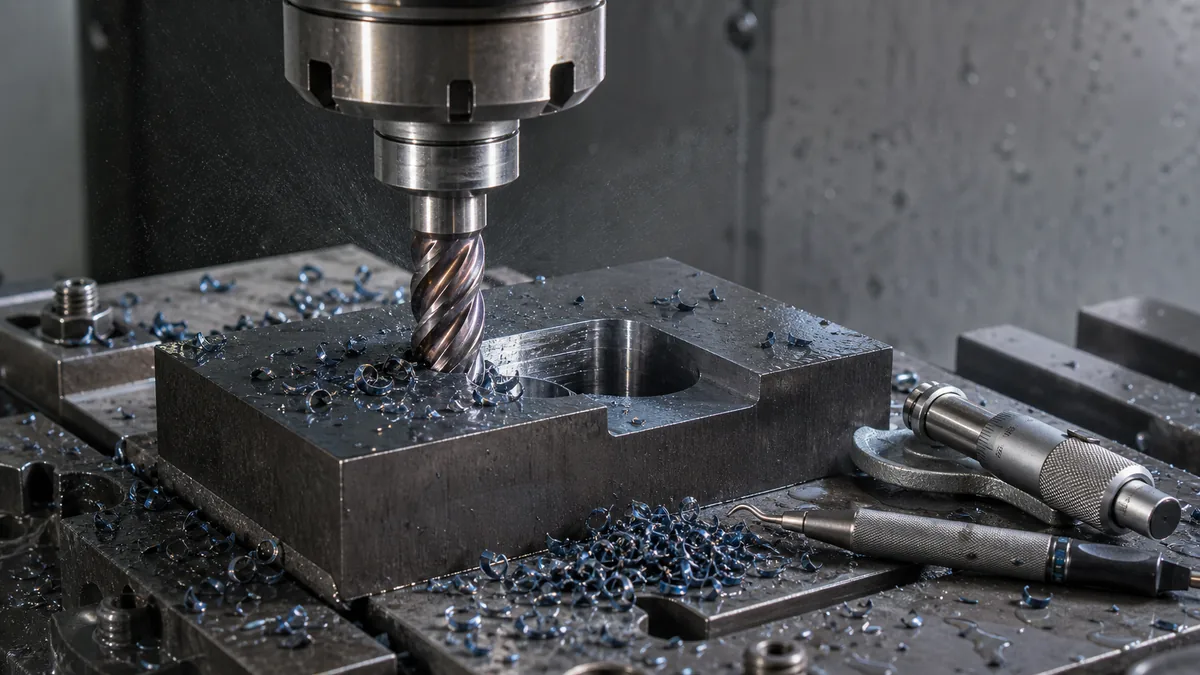
Carbon steel rewards designs that reduce tool pressure and setup instability. Use internal corner radii large enough for standard end mills. Avoid deep narrow pockets unless the feature is truly required. Provide clearance for chips and coolant. Keep thin walls thicker than an equivalent aluminum design because steel cutting forces are higher. If a slot or pocket must be deep, ask whether a stepped relief, larger radius, or two-sided machining route would reduce risk.
For shafts and turned parts, define bearing journals, threads, grooves, and shoulder radii clearly. Long slender parts may deflect during turning, so the supplier may need center support, extra stock, or a different sequence. For plates, define flatness only where it matters. A thick steel plate can move after stress relief, roughing, or heat treatment; a tight flatness callout over the whole surface may require grinding rather than normal milling.
Heat Treatment and Finishing Should Be Planned Together
Heat treatment can improve hardness, strength, or wear resistance, but it can also change dimensions and introduce distortion. If the part needs heat treatment after rough machining, leave enough stock for finish machining. If the part is machined from pre-hardened material, expect more tool wear and slower machining, but less post-heat-treatment movement. For critical fits, discuss whether the supplier should rough machine, heat treat, finish machine, and inspect in that order.
Carbon steel also needs a corrosion strategy. Oil may be enough for temporary storage, but exported parts often need better protection because ocean freight and humid warehouses can create rust. Black oxide gives mild protection and a dark appearance; zinc plating improves corrosion protection for many industrial parts; powder coating protects visible brackets and housings; electroless nickel can protect complex surfaces with uniform thickness. If threads, bearing seats, or sealing faces must stay uncoated, call out masking requirements.
| Finish option | Why buyers choose it | Design or RFQ note |
|---|---|---|
| Light oil or rust preventive | Short-term storage and low cost | Confirm packaging and expected storage environment. |
| Black oxide | Dark appearance and mild corrosion protection | Usually needs oil; not a substitute for heavy corrosion resistance. |
| Zinc plating | General corrosion protection for brackets and hardware | Account for coating thickness on threads and close fits. |
| Powder coating | Durable exterior finish on visible steel parts | Mask threads, ground points, and tight-tolerance mating faces. |
| Electroless nickel | Uniform corrosion protection on complex surfaces | Specify thickness and masking for precision features. |
Quality Checks for Carbon Steel CNC Parts
Inspection should match the function. Critical bores, shafts, and mounting datums may need micrometer, bore gauge, CMM, or surface roughness checks. Welded assemblies may need fixture inspection after welding, not only individual part inspection. Heat-treated parts may require hardness verification and dimensional inspection after treatment. Plated parts may need coating thickness checks where fits are sensitive.
Buyers should also specify deburring expectations. Carbon steel burrs can be sharp and durable, especially around drilled holes and milled slots. If the part will be handled manually or assembled with seals, define edge break requirements. For precision edges, do not simply write “deburr all edges” if a sharp functional edge must remain; identify the exception.
Carbon Steel RFQ Checklist
- State the steel grade, standard, condition, and acceptable substitutes.
- Identify whether weldability, hardness, strength, cost, or corrosion protection is the priority.
- Call out heat treatment sequence and final hardness when required.
- Separate critical fits from general dimensions to avoid unnecessary inspection time.
- Specify finish, masking, coating thickness, packaging, and rust-prevention expectations.
- Share mating parts or assembly context for bores, shafts, threads, and datum faces.
If the choice is between carbon steel and stainless steel, compare the corrosion environment and finishing cost before deciding. CNCMAVEN’s stainless steel CNC machining guide covers the stainless route, while the powder coating guide is useful when carbon steel needs a durable exterior finish.
FAQ
Is carbon steel easy to CNC machine?
Some carbon steels machine well, but machinability depends on grade and condition. Free-machining steels break chips more easily, while medium-carbon and heat-treated steels can increase tool wear and cutting force.
Does carbon steel need a surface finish after machining?
Usually yes if corrosion matters. Bare carbon steel can rust during storage, shipping, or use. Oil, black oxide, zinc plating, powder coating, and electroless nickel are common options.
Should carbon steel be heat treated before or after machining?
It depends on the tolerance and performance target. Pre-hardened stock reduces post-machining distortion, while rough machining before heat treatment may be better when final hardness is required.