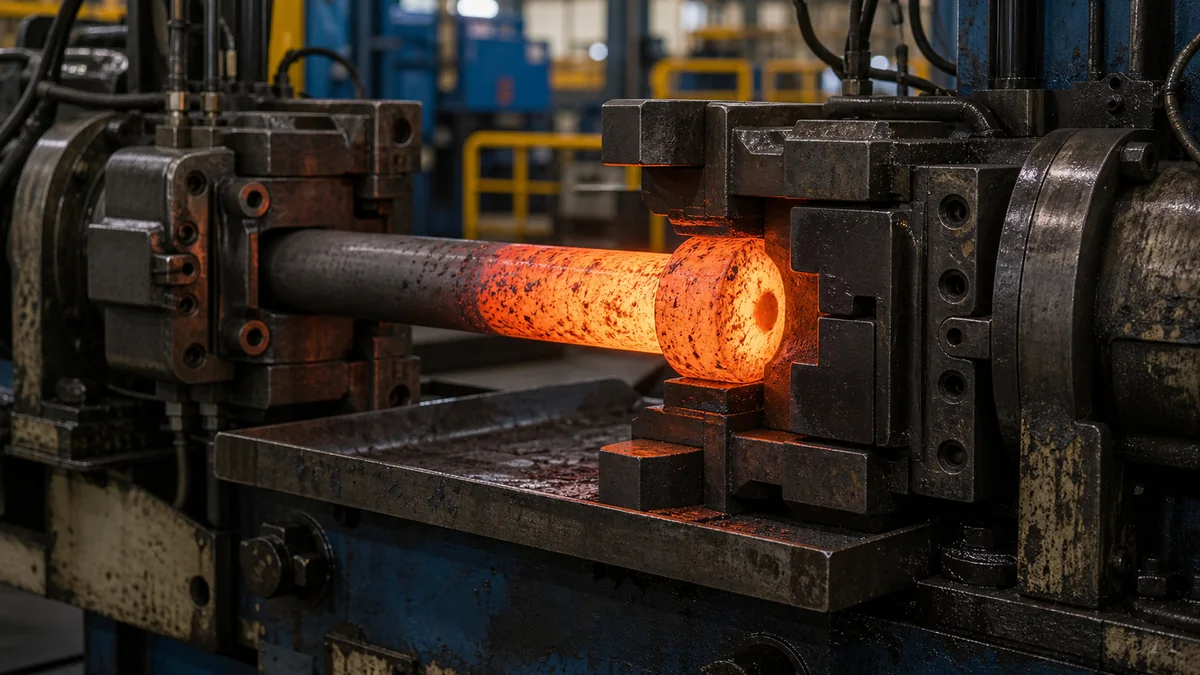
Upset forging is a good manufacturing option when a part needs a strong local enlargement, such as a head, collar, shoulder, flange, or thickened shaft end. Instead of machining the entire part from oversized bar stock, the process pushes material along the axis of a rod or wire so that one region becomes larger in diameter or thicker in section.
This matters because many headed parts fail or become expensive around the transition between a thin shank and a larger feature. Upset forging can improve material use and create favorable grain flow through that transition, but only when the blank volume, tooling, radii, and follow-up machining plan are designed correctly.
The Shape Problem Upset Forging Solves
Upset forging solves a local thickening problem. If a part is mostly a small diameter shaft but has one large head, machining it from a large bar wastes material. Welding a head onto a shank adds an assembly step and may introduce a weak joint. Upset forging forms the enlarged feature from the same continuous material.
The result is useful for parts that carry tensile, shear, or impact loads through the head-to-shank transition. However, the process does not magically create finished dimensions. Most precision parts still need trimming, heat treatment, cleaning, and CNC machining after forging.
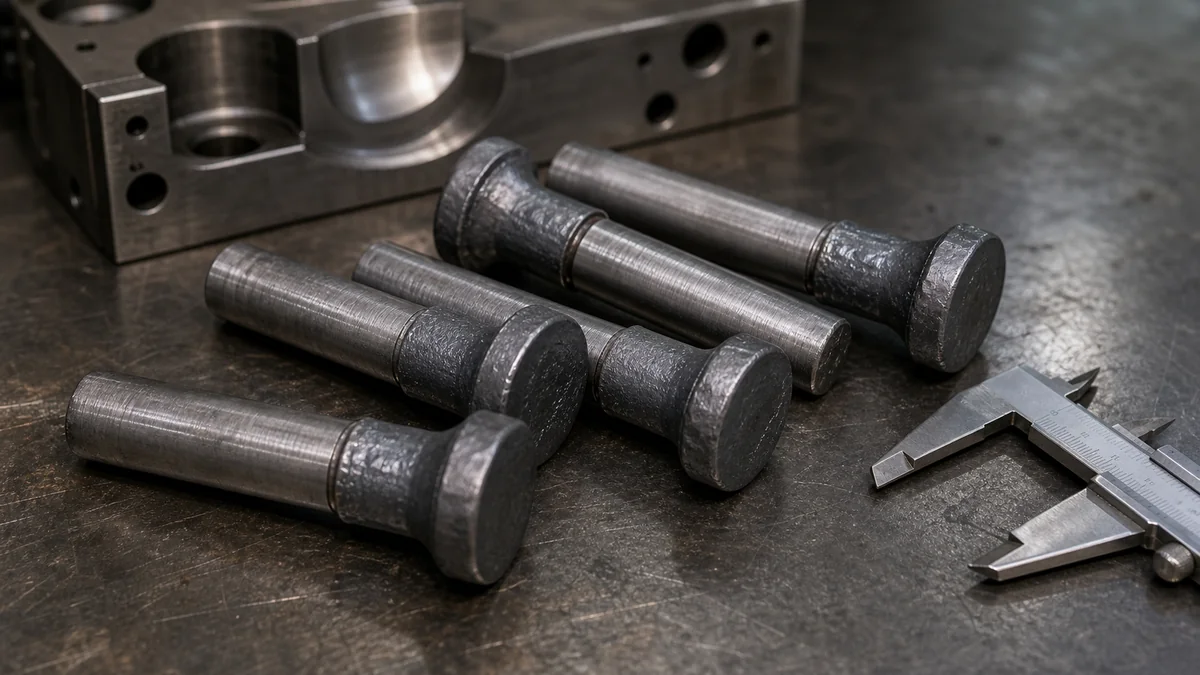
Common Upset Forged Part Types
| Part type | Why upset forging helps | Common follow-up work |
|---|---|---|
| Bolts and fastener blanks | Forms a strong head from wire or bar. | Thread rolling, trimming, heat treatment, coating. |
| Rivets and pins | Creates a formed head without separate assembly. | Shank sizing, surface finishing, inspection. |
| Shafts with collars | Adds a shoulder while keeping continuous grain flow. | CNC turning, grinding, keyway milling. |
| Valve or fitting blanks | Builds thicker local sections before machining ports. | Drilling, tapping, sealing face machining. |
| Electrical or mechanical terminals | Forms a contact or attachment head from wire stock. | Coining, plating, hole machining. |
Design Rules That Matter More Than the Head Shape
The first design question is not simply the final head diameter. A supplier also needs to understand the starting stock size, upset length, material grade, grain direction, transition radius, and whether the part will be cold formed, warm forged, or hot forged. These choices affect forming load, die life, surface finish, and risk of cracking.
- Control the head-to-shank transition: Use enough radius so material can flow without folding or cracking.
- Avoid extreme unsupported length: Long slender stock can buckle during upsetting if not guided correctly.
- Plan the volume: The enlarged feature must match the displaced material volume, including trim allowance.
- Leave machining allowance: Critical diameters, faces, threads, and sealing areas may need cleanup after forging.
- Consider material condition: Work hardening, heat treatment, and ductility influence whether cold or hot forming is realistic.
Defects and Inspection Points
Upset forging defects often appear near the transition between the shank and the enlarged feature. That is where material flow is most concentrated. Inspection should focus on fill, cracks, laps, folds, eccentricity, head height, head diameter, and whether there is enough stock for CNC finishing.
| Issue | What it means | What to check |
|---|---|---|
| Buckling | The shank bends instead of upsetting cleanly. | Unsupported length, guide tooling, forming load. |
| Cracking | Material ductility or forming severity is not suitable. | Material condition, temperature, radius, strain level. |
| Laps or folds | Material folds over itself during flow. | Preform shape, die geometry, transition design. |
| Eccentric head | The head is not aligned with the shank. | Cut length, tooling alignment, stock straightness. |
| Insufficient cleanup | Machining does not fully remove forging variation. | Machining allowance and datum strategy. |
When Upset Forging Is Not the Right Answer
Upset forging is less attractive when the enlarged feature is very complex, the volume is low, the design is still changing, or the final part needs many precision features across the entire geometry. In those cases, CNC machining, screw machining, cold heading, casting, or welded assemblies may be better depending on the material and quantity.
For prototypes, CNC machining from bar stock is often the fastest way to validate dimensions and performance. Once the geometry is stable and volume increases, upset forging can be evaluated as a production route to reduce waste and improve part strength.
Example Specification for a Supplier
A useful RFQ should tell the supplier both the finished dimensions and the manufacturing intent. A short note such as “make this by upset forging” is usually not enough.
- Send the finished drawing, 3D model, and material grade.
- Mark the head, shoulder, or collar that must be forged rather than welded.
- Identify CNC-machined surfaces, threads, datum faces, and critical concentricity requirements.
- State expected volume, heat treatment, coating, and inspection documentation.
- Ask for feedback on stock diameter, cut length, forming temperature, transition radius, and machining allowance.
CNCMAVEN can help compare upset forging against CNC turning from bar stock when material waste, head strength, and production volume are central to the decision.
Production Planning Notes
For production planning, it is useful to separate prototype validation from production conversion. A machined prototype can confirm function, but the production drawing should still be reviewed for upset forging feasibility. The supplier may suggest changing a radius, adjusting head height, adding trim allowance, or moving a tolerance from the forged blank to a later CNC operation. Those changes are easier to make before tooling than after samples are produced.
For repeat orders, keep a record of stock diameter, cut length, heat lot, forming temperature range, tooling revision, and final machining setup. These details make it easier to diagnose variation if head fill, concentricity, or thread quality changes between batches.
FAQ
What is upset forging used for?
Upset forging is used to create a larger cross-section at a local area of a bar, wire, or rod, such as a bolt head, rivet head, collar, shoulder, flange, or shaft end.
Why use upset forging instead of machining from a larger bar?
Upset forging can reduce material waste and improve grain flow because material is displaced into the head or shoulder instead of being cut away from a larger starting diameter.
Can upset forged parts be CNC machined?
Yes. Upset forging often creates the strong blank, while CNC turning, milling, drilling, threading, or grinding finishes the precision surfaces.
Conclusion
Upset forging is a practical route for strong headed parts and local thickened features. It works best when the enlarged geometry, transition radius, blank volume, inspection plan, and CNC finishing requirements are designed together from the start.