


CNC Materials Hub
Choose a manufacturing material from the part’s function, environment, geometry, process, finish, inspection, and supply requirements—not from a familiar grade name alone. This hub organizes CNCMAVEN’s published material and finishing guides by the decisions engineers and buyers need to make. Every linked resource below is currently published.
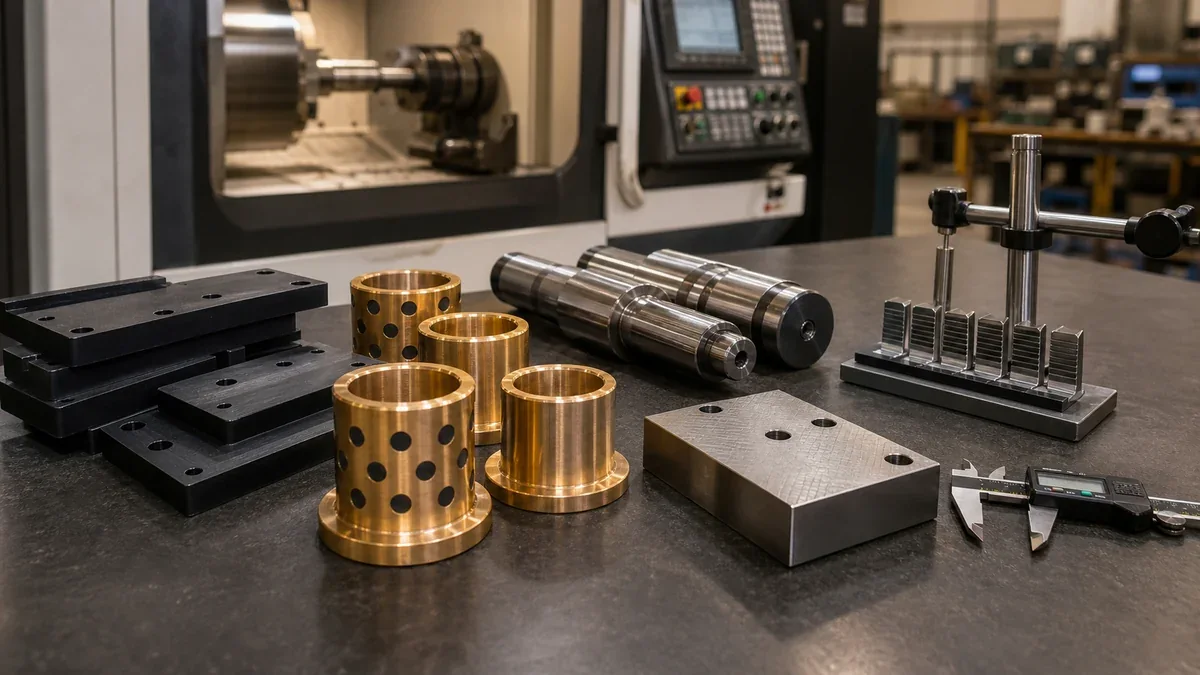
Metals: choose by function and manufacturing route
Start with the property that protects the part in service: strength, corrosion resistance, wear, heat, conductivity, mass, or response to finishing. Then check whether machining, forging, casting, sheet fabrication, or another route fits the geometry and quantity.
Plastics: select the resin before setting the tolerance
Plastic selection should account for moisture, temperature, load duration, chemical exposure, friction, electrical behavior, wall stability, and inspection condition. Avoid copying metal tolerances onto a plastic drawing without checking how the resin behaves.

Aluminum alloys: balance mass, function, process, and finish
Aluminum is not one interchangeable material. State the alloy and temper required by the design, then review stock form, machining or casting route, joining, coating, cosmetic expectations, and any controlled post-finish dimensions.
- Conductive Materials for Thermal and Electrical Parts — Evaluate aluminum alongside other conductive choices.
- Cold-Chamber Die Casting for Aluminum Parts — Compare a casting route with machined or fabricated alternatives when tooling and volume may be justified.
- Powder Coating CNC-Machined Parts — Define coating, masking, appearance, threads, and dimensional allowances.
- Bead Blasting for CNC Parts — Specify texture, cosmetic zones, masking, and handling expectations.
- تصنيع الصفائح المعدنية — Consider sheet-based cutting, bending, forming, and assembly for suitable aluminum geometry.
For supplier and RFQ guidance, see Aluminum CNC Machining.
Stainless steel and other steels
Choose steel by corrosion exposure, strength, toughness, wear, heat treatment, weldability, finish, and supply condition. “Steel” or “stainless” alone is not a complete RFQ material specification.
- Stainless Steel CNC Machining Guide — Review grade selection, corrosion needs, machining implications, and finishing.
- Choosing Carbon Steel for CNC Parts — Balance strength, cost, heat treatment, corrosion protection, and machinability.
- Tool Steel and Heat Treatment — Plan machining sequence and dimensional control around material condition.
- Designing for Wear — Define the wear mechanism before selecting hardness, treatment, or coating.
- High-Temperature Material Selection — Check oxidation, strength retention, thermal cycling, and manufacturing tradeoffs.
- Choosing a Sheet Metal Welding Method — Connect alloy, thickness, joint, distortion, and production requirements.
For supplier and RFQ guidance, see Stainless Steel CNC Machining.
Copper and brass: define the electrical, thermal, or fluid function
Copper and brass grades are selected for different combinations of conductivity, corrosion behavior, strength, machinability, sealing, and appearance. State the exact grade and the property that drives the choice.
- Choosing Conductive CNC Materials — Compare copper, aluminum, and other options for current and heat flow.
- CNC Machining Service Material Scope — Review the published service information for copper and brass machining.
- Electroless Nickel Plating for CNC Parts — Define coating function, thickness expectations, masking, and inspection before ordering.
Do not substitute one copper or brass grade for another solely because both are described as conductive. Confirm the grade, condition, required conductivity or fluid compatibility, joining method, finish, and documentation before production.
Material selection and surface finishing
Material and finish must be chosen together. A finish can change dimensions, conductivity, appearance, corrosion behavior, edge condition, thread fit, and inspection sequence.
Explore CNC Machining Services
Send the current drawing and project requirements for review.
Purchasing, traceability, and material documents
Ask for the documents your application and quality system actually require. Document names, content, traceability, inspection scope, and acceptance criteria should be defined in the RFQ rather than assumed after machining.
- Prepare a CNC Machining Quote Package — Include material designation, condition, quantity, finish, inspection, documentation, and packaging requirements.
- Quality and Inspection Before Parts Ship — Connect material control, drawing requirements, inspection, records, and release.
- CAD and Drawing Files for an RFQ — Keep model, drawing, part number, revision, and material notes aligned.
- Prototype to Volume Production — Lock material, revision, process, inspection, and change control before scaling.
- Shorten Lead Time Without Adding Quality Risk — Prevent late material or documentation decisions from delaying the order.
When the material, drawing, finish, quantity, and document scope are ready, contact CNCMAVEN for a project review and quote.
Request a Material and Project Review
Send the current drawing and project requirements for review.