Blow molding is not a replacement for CNC machining or injection molding. It is a process choice for hollow plastic parts where the buying question is usually practical: can the part be made with the required volume, wall strength, neck details, and cost target without over-engineering the tool? For product teams sourcing tanks, ducts, reservoirs, cases, bottles, and protective housings, the answer depends less on the definition of blow molding and more on geometry, material behavior, secondary operations, and inspection planning.
This guide explains when blow molding deserves a serious look, when CNC machining or injection molding is safer, and what to specify before asking for a quote.
Use blow molding when the part is truly hollow
Blow molding forms a heated plastic tube or preform against a mold cavity using air pressure. That makes it strong for enclosed or semi-enclosed shapes with continuous walls: fluid reservoirs, air ducts, chemical containers, handles, bellows, automotive washer tanks, medical housings, and packaging bodies. The process is less attractive when the part needs many precise bosses, thick ribs, flat sealing pads, or tight-tolerance mechanical features across multiple faces.
For overseas sourcing, the most common mistake is treating blow molding as a cheap version of injection molding. Injection molding is better for detailed solid parts, snap fits, ribs, threaded inserts, and tight local features. CNC machining is better for prototypes, low-volume functional parts, and geometry that must hold milled or turned tolerances. Blow molding wins when the hollow body itself is the main value and the part volume can justify tooling.
Process selection matrix for hollow plastic parts
| Requirement | Blow molding fit | Better alternative | RFQ note |
|---|---|---|---|
| Large hollow body with moderate detail | Strong fit | Rotational molding for very large low-pressure parts | Provide target capacity, wall thickness range, and leak test method |
| Small part with clips, bosses, and ribs | Weak fit | Injection molding | Separate the hollow shell from precise attachment features if possible |
| Prototype or 5-50 trial units | Usually poor fit | CNC machining, urethane casting, or 3D printing | Ask whether prototype tooling or machined samples are more economical |
| High cosmetic packaging surface | Good if tooling and resin are controlled | Injection stretch blow molding for clear bottles | Define gloss, parting line limits, and acceptable flash trimming marks |
| Precise sealing face or machined port | Possible with secondary machining | CNC-machined insert or injection molded component | Call out post-machined datums and inspection points |
DFM checks before committing to tooling
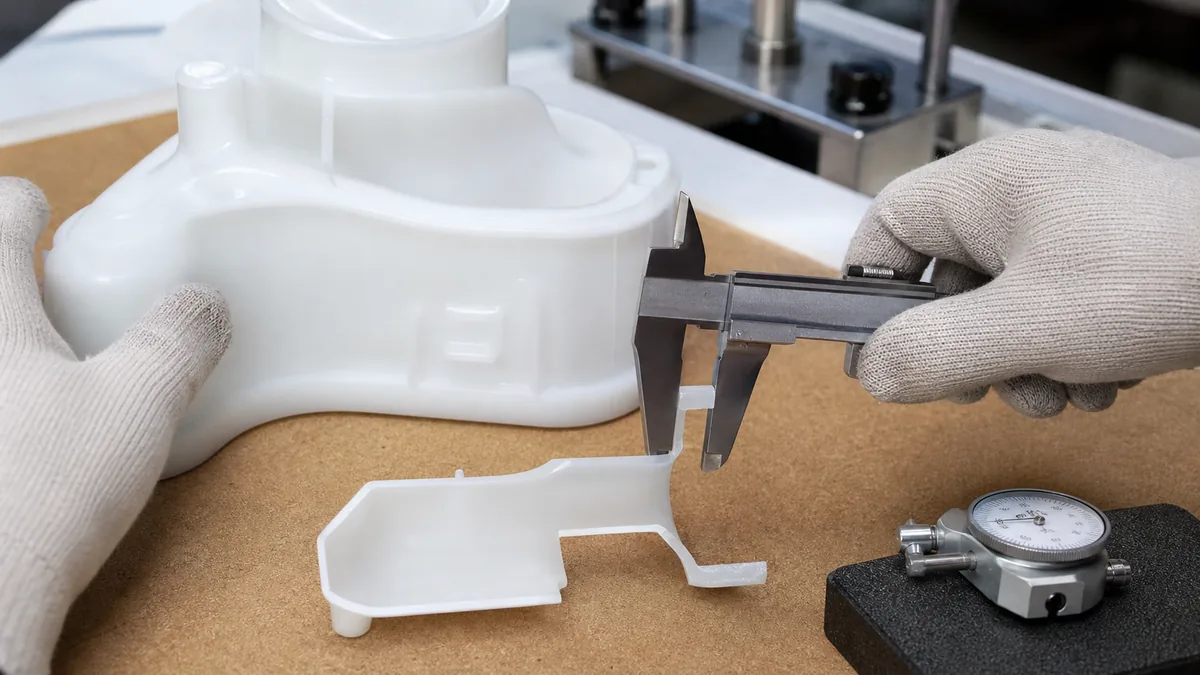
Blow molded parts need generous thinking around wall thickness. Corners, deep draw areas, handle transitions, and long flat panels can thin more than expected as the plastic stretches. A design that looks simple in CAD can fail leak tests if the wall distribution is not planned. Keep wall thickness targets realistic, avoid abrupt section changes, and leave room for parting lines, flash removal, and trimming fixtures.
Corner radii deserve early attention. Sharp external corners can thin and weaken; sharp internal transitions can trap material flow and create stress. If the part includes a neck, opening, or threaded feature, specify whether it is molded, trimmed, spin-welded, inserted, or post-machined. For assemblies, decide whether mounting points belong on the blow molded body or on a separate bracket. That choice often determines whether the part stays economical.
- Define minimum and nominal wall thickness by functional zone, not only one global number.
- Show parting line preferences and areas where flash marks are unacceptable.
- Add trimming references for openings, slots, and ports.
- Identify surfaces that need leak-tight sealing, welding, labeling, or painting.
- Use ribs, grooves, and panel shape to improve stiffness instead of simply increasing wall thickness.
Common defects and how to reduce them
| Defect | What buyers notice | Likely cause | Prevention strategy |
|---|---|---|---|
| Thin wall at corners | Weak feel, leak risk, inconsistent stiffness | Excessive stretch or sharp geometry | Increase radii, rebalance wall targets, review parison programming |
| Flash and trimming marks | Rough edges or cosmetic rejects | Parting line pressure and trim setup | Define acceptable flash height and specify trim fixture requirements |
| Warped panels | Assembly mismatch or poor appearance | Uneven cooling or large unsupported flat faces | Add shallow features, tune cooling, use assembly datums instead of cosmetic faces |
| Poor neck or port accuracy | Leaks, cap fit issues, assembly rework | Molded feature tolerance is not enough | Post-machine critical surfaces or use molded-in/inserted neck components |
| Material stress cracking | Field failures around chemicals or clips | Wrong resin or high residual stress | Match resin to chemical exposure and avoid forced assembly loads |
What to include in a blow molding RFQ
A useful RFQ should let the supplier judge process fit before quoting tooling. Send the 3D model, 2D drawing, target resin, annual volume, expected life, leak or pressure requirement, cosmetic standard, color, regulatory requirements, and packaging constraints. If the part will connect to CNC machined components, include the mating part drawings as well. This helps the supplier protect sealing faces and choose which dimensions need secondary machining.
For early development, ask for a manufacturability review before asking for the lowest piece price. The review should cover wall distribution, parting line, trim plan, inspection strategy, and whether the part should be split into a blow molded body plus separate machined or injection molded details. CNCMAVEN can also help compare the part against related processes such as injection molding, rotational molding, and CNC-machined prototypes when the design is still changing.
Practical buying takeaway
Choose blow molding when the hollow shape, volume, and material requirements are the main drivers. Avoid it when the design is dominated by precision mechanical details. The best projects usually separate the hollow body from the precision interface: blow mold the body, then machine, weld, insert, or assemble the features that need tighter control. That hybrid approach often gives buyers the best balance of tooling cost, part cost, and functional reliability.
Is blow molding cheaper than injection molding?
It can be cheaper per part for hollow bodies at the right volume, but tooling, trimming, scrap, and secondary operations must be included. Injection molding is usually better for detailed solid parts.
Can blow molded parts hold tight tolerances?
They can hold functional tolerances for many hollow products, but precision sealing faces, ports, and assembly datums often need post-machining, inserts, or a separate molded component.