CNC milling and CNC turning are not interchangeable quote labels. The better process depends on how the part is shaped, where the critical features are, how the workpiece can be held, and whether the finished geometry is mostly rotational or prismatic. Choosing the wrong process in an RFQ can slow quoting or make the supplier reinterpret the design.
This comparison gives buyers a practical way to decide which process should lead the quote for custom CNC machining, and when a part may need both.
Use turning for rotational geometry and milling for prismatic features
The fastest first decision is geometry. If the main shape is round and most features share the same centerline, CNC turning is usually the starting point. If the part has flats, pockets, slots, multiple faces, off-center holes, or complex 3D surfaces, CNC milling is usually the better starting point.
A shaft, bushing, spacer, threaded pin, or round nozzle often belongs on a lathe. A bracket, enclosure, manifold, fixture plate, heat sink, or rectangular housing usually belongs on a mill. Some parts need both: a turned blank may later be milled for flats, cross holes, wrench slots, or mounting faces.
Source: Wikimedia Commons / Impressionmanufacturer, CC BY-SA 4.0
Compare the process by part features
A drawing often contains enough clues to choose the lead process. Use the table below before sending the RFQ.
| Part feature | Usually favors turning | Usually favors milling | Buyer note |
|---|---|---|---|
| Main outside shape | Cylindrical, conical, stepped, or threaded around one axis | Block, plate, bracket, housing, or irregular profile | Send CAD and drawing; do not rely on a part name alone |
| Critical surfaces | OD, ID, grooves, faces, shoulders, concentric features | Pockets, slots, bosses, faces, hole patterns, 3D contours | Mark datums and critical dimensions clearly |
| Workholding | Bar stock, chucking, collet, or center support | Vise, fixture plate, soft jaws, tombstone, or custom fixture | Thin walls and awkward clamping can drive cost |
| Best production fit | Round parts, repeated diameters, threads, grooves | Multi-face components, flat mounting surfaces, complex hole patterns | Volume can justify custom fixtures or combined operations |
| Secondary operations | Cross holes, flats, slots, milled wrench features | Turned bosses, round bearing seats, lathe-finished diameters | Ask whether mill-turn or separate setups are best |
Many real parts need both milling and turning
Do not force a part into one process if the geometry says otherwise. A cylindrical valve body may need turning for the main diameter and milling for ports. A connector shell may need turned threads and milled flats. A shaft with a keyway may start on a lathe and move to a mill. The supplier’s routing decision should depend on tolerance stack-up, workholding, volume, and available equipment.
For complex parts, ask whether the supplier would quote separate milling and turning operations, a mill-turn machine, or a simplified redesign. Mill-turn can reduce setups for the right geometry, but it is not automatically cheaper for every part. If the part has only one simple cross hole, a separate secondary operation may be more practical. If it has many angular features around a turned body, combined machining may reduce handling and datum shift.
Milling is stronger for faces, pockets, slots, and hole patterns
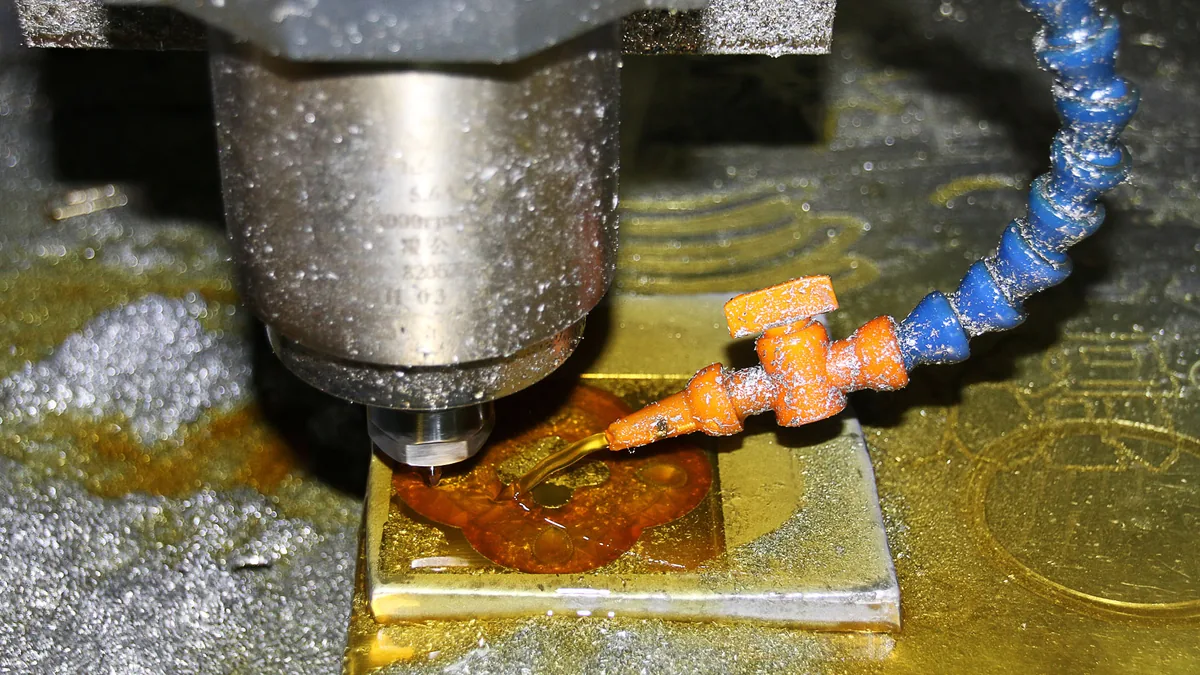
CNC milling removes material with rotating cutting tools while the workpiece is fixed or indexed. It is the better process when the part needs flat datum faces, pockets, slots, bosses, drilled hole arrays, chamfers, and features on several sides. The number of setups can increase when features exist on many faces, especially if tight positional tolerances connect those faces.
Source: Wikimedia Commons / Impressionmanufacturer, CC BY-SA 4.0
Design for milling by giving the tool room to reach internal corners, avoiding unnecessarily deep narrow pockets, and using internal radii that match practical cutter sizes. CNCMAVEN’s DFM considerations for CNC milling cover related details for pockets, walls, and tool access.
Turning is stronger for diameters, grooves, threads, and concentricity
CNC turning rotates the workpiece while a cutting tool shapes the diameter, face, bore, groove, or thread. It is efficient for round components because concentric features can be produced from the same axis. Turning can also produce clean surface finishes on cylindrical features when the material and toolpath are appropriate.
Design for turning by identifying the primary datum axis, avoiding impossible internal grooves, and checking whether long slender parts need center support. If the part has a very high length-to-diameter ratio, vibration and deflection can affect tolerance and finish. If it has cross holes or flats, mark whether those features are critical to the turned datum.
Cost drivers differ between milling and turning
Cost is not only machine time. The process changes material form, setup count, fixture needs, tool access, inspection time, and finishing risk.
| Cost driver | Milling impact | Turning impact |
|---|---|---|
| Raw material | Plate, block, extrusion, or saw-cut billet may create more waste for deep pockets | Bar stock can be efficient for round parts but wasteful for non-round geometry |
| Setup count | Multiple faces may require several setups or indexed machining | Second-side work and off-axis features add operations |
| Tool access | Deep narrow pockets and small internal radii increase machining time | Deep bores, grooves, and slender shafts need careful tooling |
| Inspection | Hole position, flatness, and multi-face datums can add CMM time | Concentricity, runout, thread gauges, and bore checks may dominate |
Send an RFQ that lets the supplier choose the best route
If you are unsure whether the part should be milled, turned, or both, say so in the RFQ. A good supplier can recommend the routing if the quote package is complete. Include 3D CAD, 2D drawings, material, finish, quantity, tolerance notes, critical dimensions, and which surfaces are cosmetic or functional. CNCMAVEN’s CNC quote package guide explains what to send for accurate pricing.
- For a round part: identify the main axis, critical OD/ID features, thread requirements, groove details, and runout or concentricity needs.
- For a milled part: identify datum faces, hole patterns, pocket depths, internal radii, cosmetic faces, and any features requiring 3-axis, 4-axis, or 5-axis access.
- For mixed geometry: ask whether the supplier recommends mill-turn, turning plus secondary milling, or a small design change to reduce setups.
If access angle is part of the issue, review the differences between 3-axis, 4-axis, and 5-axis CNC machining before finalizing the drawing.
FAQ
Is CNC turning cheaper than CNC milling?
Turning can be cheaper for round parts because the geometry fits bar stock and lathe workholding, but it is not automatically cheaper when off-axis features or secondary milling are required.
Can one CNC part use both milling and turning?
Yes. Many shafts, valve bodies, connector shells, and round housings use turning for the main diameter and milling for flats, cross holes, slots, or mounting features.
Should I tell the supplier which process to use?
If the process is fixed for a reason, state it. If not, provide complete CAD, drawings, material, finish, quantity, and critical tolerances so the supplier can choose the most efficient route.
The practical rule is simple: lead with turning when the part is mainly rotational, lead with milling when the part is mainly prismatic, and let the supplier evaluate combined operations when the drawing contains both. A clear RFQ helps prevent process assumptions from turning into quote delays or avoidable machining cost.